Zero Emissions Day: Why Better Homes Matter in the Move Towards Net Zero

Zero Emissions Day: Why Better Homes Matter in the Move Towards Net Zero
When people hear the words net zero, they may think about electric cars, wind farms, solar farms or large businesses cutting their carbon emissions.
But there is another part of the picture much closer to home.
Our homes.
Every day, millions of homes need energy for heating, hot water, lighting and appliances. When a home loses heat too quickly or uses energy poorly, more energy may be needed simply to keep the people living there comfortable.
That is why improving homes matters.
But there is a problem.
Retrofit cannot become a race to install as much as possible, as quickly as possible.
A measure may look simple on paper. Install insulation. Fit a new heating system. Add solar panels. Improve ventilation.
Job done.
Except it is rarely that simple.
A home is a whole building. Change one part and it can affect another.
Poorly planned work can create problems rather than solve them.
The homeowner may be left with a home that does not perform as expected. The installer may be left trying to explain missing evidence. The business may find problems during an audit. And money intended to improve homes may not deliver the benefits everyone expected.
Zero Emissions Day gives us a useful reason to think about this.
If better homes are going to play their part in the move towards net zero, we need more than good intentions.
We need good work.
And good work starts with the right processes.
Net Zero Is a Huge Goal, but It Comes Down to Individual Decisions
Net zero can sound enormous.
It is easy for a small retrofit business to wonder what difference its work can really make.
One property.
One installation.
One team.
One day at a time.
Yet this is exactly where change happens.
Every home that is improved properly has the potential to use energy more effectively.
Every installer who follows the correct process helps protect the quality of the work.
Every business that takes its responsibilities seriously helps build greater trust in retrofit.
That matters.
Because the move towards net zero cannot depend only on large promises.
It also depends on what happens inside individual homes.
The small details matter.
Was the property properly considered before the work began?
Was the right measure used?
Did the installation follow the required process?
Were problems identified?
Was the work checked?
Were the correct photographs taken?
Is there enough evidence to show what happened?
These questions might not sound as exciting as talking about the future of clean energy.
But they are important.
Because targets are only useful if the work being completed to support them actually delivers.
Better Homes Are About More Than Lower Energy Use
When we talk about improving the energy performance of a home, it can be tempting to focus on one thing.
Energy.
But the people living in that property care about much more than a number.
They want their home to feel comfortable.
They want it to be warm when it is cold outside.
They do not want new problems with damp, mould or poor ventilation.
They want to understand what has been installed.
They want to know how to use it.
And they want to feel confident that the work has been completed properly.
This is why quality matters so much.
Imagine a homeowner has insulation installed because they have been told it could help their home retain heat.
That sounds positive.
But what if the work has not been properly considered alongside ventilation?
What if important details are missed during the installation?
What if nobody records enough evidence?
Suddenly, something intended to improve the home could create questions or problems.
That does not help the homeowner.
It does not help the installer.
And it does not help build confidence in retrofit.
The move towards net zero needs people to trust the work being carried out in their homes.
That trust has to be earned.
PAS 2030 Helps Turn Good Intentions Into a Clear Process
This is where PAS 2030 and net zero become closely linked.
PAS 2030 sets requirements around the installation of energy efficiency measures in existing homes.
For installers, this means there is a clear process to follow.
That process matters because retrofit work is not just about whether something looks good when the installer leaves.
There needs to be confidence in how the work was carried out.
Businesses need to think about competence, processes, checks, records and evidence.
The installation itself remains vital, of course.
But so does everything around it.
This can sometimes feel frustrating to installers.
An experienced person may look at a completed job and know that it has been installed well.
So why all the paperwork?
Why all the photographs?
Why all the records?
Why all the checks?
Because someone who was not standing beside the installer needs to be able to understand what happened.
Good evidence tells the story of the installation.
It shows that important stages were considered.
It supports the business during checks and audits.
And, importantly, it helps protect the customer too.
This is why PAS should not be viewed as something separate from quality.
The process is there to help businesses show that quality.
A Good Installation Needs Good Evidence
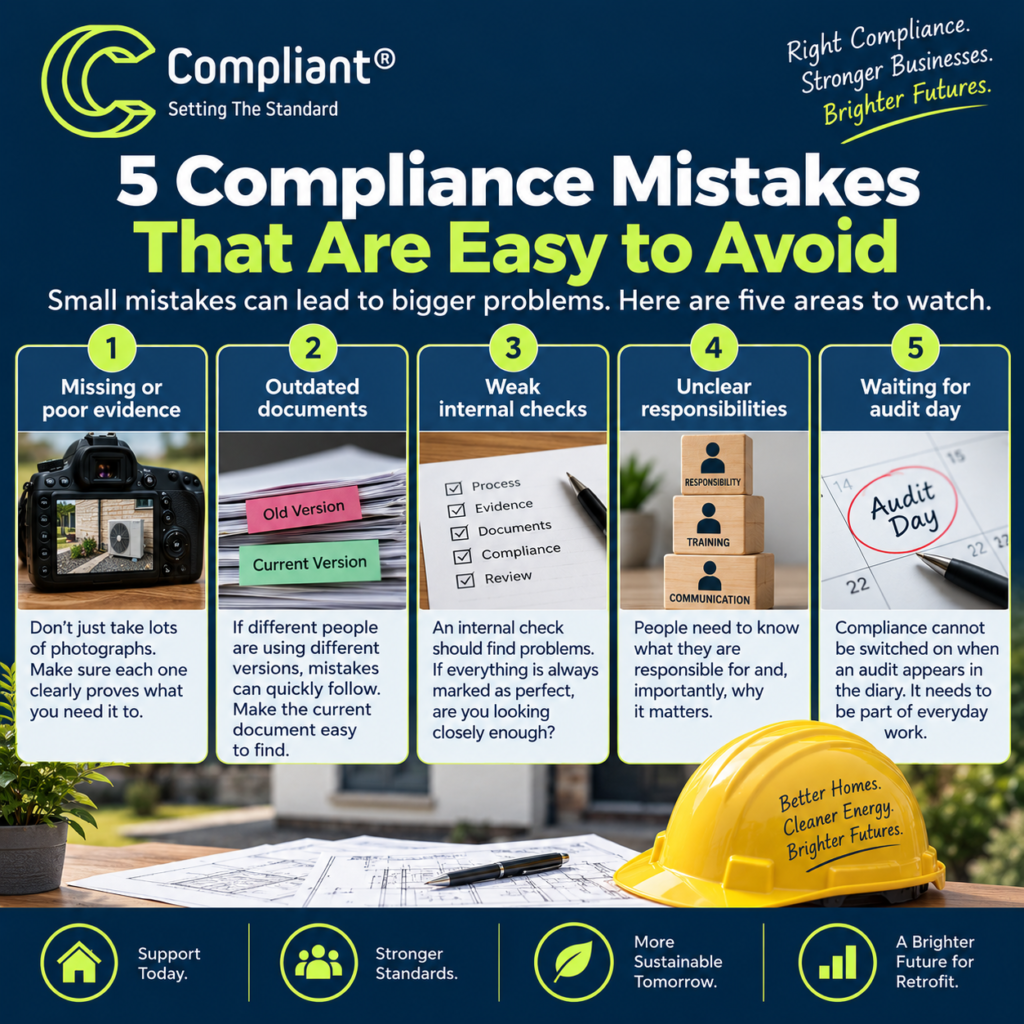
One of the most common areas that can cause problems for retrofit businesses is evidence.
The work may have been completed correctly.
But can the business prove it?
Think about a normal working day.
The installer arrives at the property. There is a lot to do. Materials need to be checked. Work needs to be completed. The customer may have questions. Something unexpected may be found.
The team is focused on getting the job right.
Then somebody remembers the photographs.
Perhaps one is taken.
Perhaps an important stage has already been covered up.
Perhaps the image is too dark.
Maybe the photograph does not clearly show what the auditor needs to see.
The installation itself may be fine.
But the evidence now has a gap.
That can become a much bigger problem later.
Good evidence needs to be part of the job, not something added at the end.
Teams need to understand what must be recorded before work starts, while it is being completed and once it is finished.
That simple change in thinking can make a huge difference.
Instead of asking:
“Have we got some photos?”
The question becomes:
“Do we have the evidence needed to tell the full story of this installation?”
Those are two very different things.
Quality Cannot Be Switched On for Audit Day
Another important lesson for businesses working under PAS 2030 is that compliance cannot be something that only matters when an audit is approaching.
It needs to be part of normal work.
Every job.
Every team.
Every day.
Waiting until an audit is booked to check files creates pressure.
Suddenly, people are searching for photographs from jobs completed months ago.
Documents cannot be found.
Someone remembers that a member of staff has left the business.
A record was saved on a different computer.
Nobody can remember exactly what happened on a particular installation.
This is stressful.
It is also avoidable.
A strong system should help the business stay ready as work is completed.
Records should be kept properly.
Evidence should be checked.
Problems should be picked up early.
Staff should understand what is expected of them.
When this happens, an audit becomes much less about trying to fix the past.
Instead, it becomes a chance to show what the business is already doing.
That is a much healthier way to work.
Small Mistakes Can Become Expensive Problems
Retrofit businesses are busy.
When work is coming in and teams are under pressure, process can sometimes feel like the thing slowing everyone down.
But poor process can cost far more time.
Imagine discovering that several completed jobs have the same evidence missing.
Someone now has to investigate.
Files need to be checked.
Staff may need to be contacted.
Customers might need to be revisited.
The business may have to explain what happened.
All because a simple check was not completed at the right time.
The same principle applies to training, documents and internal checks.
Small gaps can grow when nobody notices them.
This is why businesses should not wait for an external auditor to find problems.
Regular internal checks are valuable because they give the business a chance to spot weaknesses first.
That might be a missing record.
An old document.
A process that staff are not following.
Photographs that are regularly unclear.
Or a team member who needs more support.
Finding a problem internally gives the business the opportunity to understand it and improve.
That is far better than discovering it when somebody else is checking the system.
Net Zero Needs Quality as Well as Quantity
There is understandable pressure to improve more homes.
But numbers alone cannot tell us whether retrofit is working.
Imagine two projects.
One completes a large number of installations very quickly, but records are poor, checks are inconsistent and problems are discovered afterwards.
The other takes a controlled approach. Teams understand what is required. Evidence is gathered throughout the work. Problems are identified early and lessons are used to improve future installations.
Which approach is more likely to create lasting confidence?
This is why quality and quantity cannot be treated as opposites.
We need homes to be improved.
But we also need those improvements to be suitable and properly installed.
If the move towards net zero creates poor experiences for customers, trust can fall.
And trust matters enormously.
People talk.
A homeowner who has a good experience may feel more confident about future improvements.
A homeowner who has a bad experience may tell family, friends and neighbours.
That experience can shape how people feel about retrofit as a whole.
Quality therefore reaches far beyond one installation.
The People Inside the Business Matter
PAS compliance is not just the responsibility of one person sitting in an office.
Everyone involved has a part to play.
Managers need to make sure the right processes are in place.
People responsible for quality need to check that those processes are working.
Installers need to understand what is expected at the property.
Office teams need to know how records should be stored.
Anyone taking photographs needs to understand what those photographs are supposed to prove.
And when something goes wrong, people need to feel able to report it.
This is where some businesses struggle.
They may have good documents.
They may have written procedures.
But the people doing the work do not fully understand them.
A process nobody follows is not doing much good.
Good PAS management should make work clearer, not harder.
Staff should know what they need to do and why they need to do it.
That “why” is important.
If someone believes photographs are simply extra paperwork, they may rush them.
If they understand that those photographs protect the customer, the installation and their own work, they are more likely to see their value.
Education is part of good compliance.
Better Processes Can Make Life Easier
There is a common fear that stronger compliance means more work.
Sometimes the opposite is true.
Poor systems create work.
Searching for missing documents creates work.
Correcting the same mistake repeatedly creates work.
Preparing everything at the last minute before an audit creates work.
Revisiting a property because evidence was missed creates work.
Answering questions that could have been prevented by a simple check creates work.
A clear process can reduce that waste.
For example, imagine every installation team has a simple, understood method for collecting evidence.
They know which photographs are required.
They know when to take them.
They know where to save them.
Someone checks the evidence before the job is considered complete.
A missing photograph can then be identified while there may still be an opportunity to deal with it.
Compare that with finding the gap six months later.
The first approach may take a little discipline.
The second can take hours of unnecessary work.
Good compliance should support the business, not fight against it.
Why PAS Consultant Support Can Help
PAS requirements can be difficult for businesses to manage alongside everyday work.
Managers are already dealing with customers, staff, jobs, suppliers, money and deadlines.
Installers are focused on completing work safely and correctly.
Adding certification requirements, evidence, records, internal checks and audit preparation can feel like another job on top of everything else.
This is where the benefits of PAS consultant support can become clear.
A good PAS consultant should not simply tell a business what to do.
They should help the business understand why it needs to be done.
That distinction matters.
If a consultant simply hands over a collection of documents, the business may technically have paperwork.
But does the team understand it?
Does it match how the company actually works?
Will people use it?
Will it help when an audit takes place?
Support should help make the requirements easier to understand and manage.
It can also provide another pair of eyes.
When people work with the same system every day, small problems can become normal.
A missing step may no longer stand out.
An old document might continue being used because nobody has noticed it needs reviewing.
Evidence may look acceptable until somebody asks what it actually proves.
Regular support can help spot these weaknesses earlier.
The aim should not be to make the business dependent on a consultant.
It should be to help the business become stronger in its own understanding.
PAS Support Should Be About More Than Passing an Audit
Passing an audit is important.
But it should not be the only goal.
If all the work is focused on one audit date, the business can fall into a cycle.
Panic before the audit.
Pass the audit.
Relax.
Then panic again when the next one approaches.
That is exhausting.
A better approach is to build PAS requirements into normal business activity.
The system stays alive between audits.
Documents are reviewed.
Evidence is checked.
Staff are supported.
Changes are understood.
Problems are dealt with.
Internal checks happen regularly.
Then audit preparation becomes much more manageable because the business is not trying to rebuild months of missing information.
A PAS consultant can support this approach by helping the company understand where attention is needed throughout the year.
That can be especially valuable when requirements change or when the business wants to add new measures.
Instead of reacting at the last moment, the company can prepare.
Every Good Retrofit Job Adds to the Bigger Picture
Zero Emissions Day encourages people to consider the effect emissions have on the world around us.
For the retrofit sector, there is a very practical connection.
Better homes can be part of a lower-carbon future.
But only when improvements are made properly.
That means looking beyond the measure itself.
It means thinking about the property.
The customer.
The installation.
The people carrying out the work.
The evidence.
The checks.
And the long-term result.
PAS 2030 gives installers a framework for approaching that responsibility.
It does not mean mistakes will never happen.
No business can promise that.
What matters is having processes that help prevent problems, identify them when they occur and learn from them afterwards.
That is what continuous improvement should look like in the real world.
Not perfection.
Progress.
Better Homes Need Businesses That Care About the Details
The journey towards net zero will not be completed by one big action.
It will be built from thousands of smaller ones.
A properly completed survey.
A correctly installed measure.
A photograph taken at the right moment.
A member of staff asking a question because something does not look right.
An internal check finding a problem before an audit.
A manager taking time to improve a process.
A consultant helping a business understand a requirement rather than simply giving it another document.
Individually, these things may seem small.
Together, they help create better retrofit.
And better retrofit can help create better homes.
That is the connection worth remembering this Zero Emissions Day.
Net zero is a huge national and global ambition, but the work behind it often happens at a very human level.
Inside someone’s home.
Completed by an installer.
Managed by a business.
Checked through evidence.
And experienced by a customer.
Use Zero Emissions Day as a Reason to Review Your Own Process
Businesses involved in retrofit do not need to solve net zero on their own.
But they can look at the part they control.
That is a useful place to start.
Take one recent installation and follow it from beginning to end.
Look at the records.
Check the photographs.
Ask whether someone who was not there could understand exactly what happened.
Look at whether the correct processes were followed.
Ask your team which parts of PAS they find hardest to understand.
Check whether the same mistakes appear more than once.
And consider whether your system is helping your people get the job right or simply giving them more paperwork.
If you use PAS consultant support, use that time to ask questions.
Do not just ask, “Will this pass an audit?”
Ask:
“Why do we need this?”
“What problem is this process designed to prevent?”
“Could we make this clearer for our installers?”
“Are we collecting the right evidence?”
“Where are our biggest gaps?”
“What could we improve before our next job?”
Those questions create knowledge.
Knowledge creates better decisions.
And better decisions can lead to better work.
Zero Emissions Day may last for just one day.
The work required to create better, more energy-efficient homes happens throughout the year.
So rather than treating net zero as a distant target, bring it back to the next property, the next installation and the next decision your business makes.
Get those details right.
Learn when something goes wrong.
Keep improving the process.
Because better homes will matter in the move towards net zero.
And quality retrofit will help make sure those improvements are built to last.