
5 Compliance Mistakes That Are Easy to Avoid
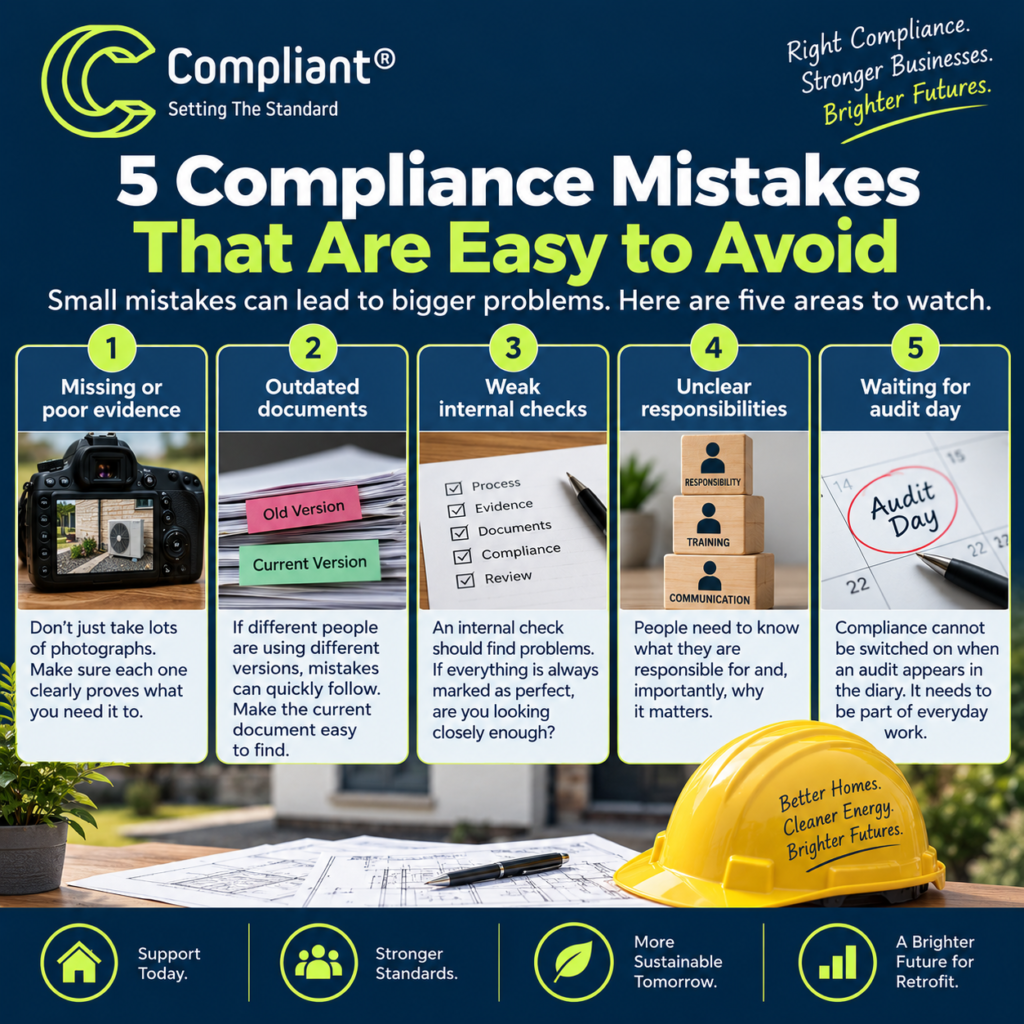
5 Compliance Mistakes That Are Easy to Avoid
Everything seems fine.
Installations are being completed.
Customers are happy.
The team is busy.
Then the audit date arrives.
Suddenly, somebody starts looking closely at the records.
A photograph is missing.
Then another one.
A document has not been reviewed.
An internal check should have happened months ago.
Someone is using an old version of a form.
Another member of staff has been completing a process differently because they misunderstood what was expected.
Now the pressure starts.
Emails fly around.
People search old folders.
Installers are asked about jobs they completed months ago.
Documents are hurriedly reviewed.
Everyone is trying to work out what happened and how to fix it.
The frustrating part?
Many of these problems could have been avoided.
Some of the most common PAS 2030 compliance mistakes are not huge failures.
They are small gaps.
But small gaps can become much bigger when they are repeated across dozens of installations.
The answer is not to panic before every audit.
It is to build simple checks into everyday work.
Here are five mistakes worth looking for.
Mistake 1: Missing or Poor Installation Evidence
This is one of the easiest problems to understand.
The work may have been completed properly.
But can you prove it?
An installer knows what happened because they were standing there.
An auditor was not.
Someone reviewing the file needs evidence that helps them understand the installation.
This is where photographs and records become important.
The mistake businesses sometimes make is thinking that having photographs is enough.
It isn’t.
A photograph needs to show something useful.
Imagine opening a job file and finding 40 images.
That sounds good.
Then you look at them.
Several show almost exactly the same thing.
Some are too dark.
One is blurry.
Important details cannot be seen.
There are plenty of photographs, but the evidence you actually need is missing.
That is not a photography problem.
It is a process problem.
Think Pre, Mid and Post
Evidence should be considered throughout the installation.
Pre-installation evidence records the starting point.
Mid-installation evidence can capture important details while the work is taking place.
Post-installation evidence shows the completed work.
All three stages matter because some details are only visible for a short time.
Once something has been covered, it may be impossible to photograph later.
This is why saying, “We’ll get the photos at the end,” can create problems.
By the end, the evidence opportunity may have gone.
Stop Asking for “Lots of Photos”
Instead, tell installers what each photograph needs to prove.
There is a big difference between:
“Take plenty of pictures.”
And:
“Before you move to the next stage, we need a clear image showing this detail.”
The second instruction has purpose.
It is easier to follow.
It is easier to train.
And it is easier to check.
A useful question for every photograph is:
What does this prove?
If nobody can answer, ask whether that photograph is useful.
Then ask the opposite question:
What do we need to prove that we haven’t photographed?
That is often where the real gaps appear.
Check Evidence While the Job Is Fresh
Do not wait until an audit to discover missing evidence.
Build a check into the normal job process.
Once an installation is complete, review the evidence.
Is everything there?
Is it clear?
Can someone who was not at the property follow what happened?
If something is missing, finding out now gives you a better chance of dealing with it.
Finding out six months later is much harder.
Mistake 2: Using Outdated Documents
This mistake can happen very quietly.
A document is created.
Everyone starts using it.
Time passes.
Something changes.
A new version is produced.
But the old version is still saved on someone’s computer.
Another copy is sitting in a shared folder.
An installer has one downloaded on a tablet.
Before long, different people are using different documents.
Nobody intended to do anything wrong.
But the document control has failed.
Why Does This Matter?
Your processes and forms help guide the way work is completed and recorded.
If people use old information, they may follow an old process.
They might collect the wrong information.
They could miss something that has changed.
This is why documents should not simply be created and forgotten.
They need to be controlled.
The business should know which version is current.
Staff should be able to find it easily.
Old versions should not be sitting somewhere people could accidentally use them.
And documents should be reviewed when required.
Make the Right Document the Easy One to Find
People usually take the quickest route.
If the current document takes ten minutes to find but an old copy is sitting on someone’s desktop, which one are they likely to open?
Your system needs to make the correct choice easy.
Think about where documents are stored.
Who can change them?
How changes are communicated.
How old copies are controlled.
And how staff know they are using the current version.
Keep it simple.
A complicated document system can create its own mistakes.
Review Your Documents Before You Need To
Do not wait for an auditor to ask:
“When was this last reviewed?”
Set a process.
Check important documents regularly.
If nothing needs changing, record the review where appropriate.
If something has changed, update it properly and make sure the people affected understand the change.
A document review should not be about changing words just for the sake of it.
The real question is:
Does this still reflect what we actually do and what is required?
If not, it needs attention.
Mistake 3: Internal Checks That Do Not Really Check Anything
Internal checks can be incredibly valuable.
They give a business the chance to find problems before an external auditor does.
But only if they are meaningful.
A weak internal check can become another box-ticking exercise.
Everything is marked as fine.
No questions are asked.
Nothing changes.
Then an external audit finds several problems.
That should make the business ask an uncomfortable question:
Why didn’t we find these ourselves?
Internal Checks Should Find Things
Finding a problem during an internal review is not automatically bad news.
In many ways, it means the process is doing its job.
You found something.
Now you can deal with it.
The aim should not be to produce a perfect report.
It should be to understand what is actually happening.
Take a sample of installation files.
Do not choose only the neatest ones.
Look at normal jobs.
Review the evidence.
Check the records.
Look at whether the process was followed.
Speak to people.
Ask questions.
If something does not make sense, investigate it.
Look for Patterns
One missing photograph could be a simple mistake.
The same photograph missing from eight jobs is a pattern.
That tells you something.
Perhaps the team does not understand the requirement.
Maybe the checklist is unclear.
Perhaps nobody is checking the evidence before jobs are closed.
The individual missing photograph matters.
But the pattern matters more.
Fixing one file deals with one problem.
Fixing the cause can prevent the problem happening again.
That is much more valuable.
Do Not Turn Internal Checks Into a Blame Exercise
If people believe an internal check exists to catch them out, they may become defensive.
That makes learning harder.
The aim should be improvement.
If an installer has misunderstood an evidence requirement, explain it.
If a process is unclear, improve it.
If someone needs training, provide it.
Ask:
What happened?
Why did it happen?
Could it happen again?
What can we change?
Those questions move the business forward.
Mistake 4: Staff Do Not Understand Their Responsibilities
A business can have excellent procedures.
Beautiful forms.
Detailed checklists.
Everything looks perfect in a folder.
But what happens when you ask the people doing the work about them?
This is where another common compliance mistake appears.
The system says one thing.
People do another.
Sometimes staff do not know a process exists.
Sometimes they have been shown it but do not understand why it matters.
Sometimes responsibilities are unclear.
Everyone assumes somebody else is doing the check.
Then nobody does it.
A Procedure Nobody Follows Is Not Helping You
Compliance needs to work in the real world.
On site.
In the office.
On a busy Monday morning.
When staff are under pressure.
That means processes need to be understandable.
If people need a dictionary to understand an instruction, it is probably too complicated.
If a checklist is so long that staff rush through it without thinking, ask whether it is working.
If several people interpret the same instruction differently, make it clearer.
The goal is not to make the system look impressive.
The goal is to help people get the work right.
Explain Why
This is one of the simplest ways to improve compliance.
Do not just tell people what to do.
Explain why.
Why do we need this photograph?
Why does this check matter?
Why must this record be completed now?
Why are we changing this process?
When people understand the purpose, the action makes more sense.
Consider the difference.
“Take this photograph because PAS says we need it.”
Compared with:
“Take this photograph now because this detail will be covered during the next stage. If we miss it, we may not be able to prove the work later.”
The second explanation creates understanding.
And understanding helps people remember.
Check Understanding Instead of Assuming It
Training should not end when information has been given.
Ask questions.
Show examples.
Let staff explain the process back to you.
Look at their actual work.
If the evidence shows they have misunderstood something, deal with it early.
Never assume that because an email was sent, everyone understands the change.
Communication is only successful when the message has been understood.
Mistake 5: Only Thinking About Compliance When an Audit Is Coming
This may be the biggest mistake of all.
The audit date goes into the calendar.
Suddenly compliance becomes everyone’s priority.
Files are checked.
Evidence is chased.
Documents are reviewed.
Internal checks are completed.
People start asking questions.
For a few weeks, the business becomes completely focused on PAS.
Then the audit finishes.
Everyone relaxes.
Normal work continues.
Until the next audit.
This creates a cycle of stress.
It also misses the point.
Compliance Cannot Be Switched On and Off
PAS requirements should be part of everyday work.
The installation team should collect evidence because that is how jobs are completed.
Documents should be reviewed because keeping information current is part of running the system.
Internal checks should happen because the business wants to know whether its processes work.
Training should happen because people need the right knowledge.
None of these things should exist only for an auditor.
If they do, the business will always be preparing for compliance instead of working compliantly.
Imagine If Every Job Was Audit Ready
Think about how different audit preparation could feel.
An auditor asks for an installation file.
You do not worry about which one they will choose.
The evidence was already checked when the job was completed.
The records are stored properly.
Your documents are current.
Internal reviews have already identified and addressed issues.
Staff understand their roles.
Does that mean the auditor will never find anything?
No.
No business should expect perfection.
But you are in a much stronger position because your system is alive throughout the year.
Audit Day Should Not Be a Performance
The best audit preparation happens long before the audit date.
It happens on an ordinary Tuesday when an installer remembers the correct mid-installation photograph.
It happens when someone notices an old form and replaces it.
It happens when an internal check identifies a repeated mistake.
It happens when a member of staff asks for clarification instead of guessing.
It happens when a manager takes a small issue seriously before it becomes a large one.
Those everyday actions build audit readiness.
Why Small Compliance Mistakes Become Big Problems
Most businesses do not decide to create compliance problems.
They grow.
A photograph is missed.
Nobody notices.
Another installer makes the same mistake.
Then another.
Six months later, somebody checks.
Now the business does not have one evidence gap.
It has 30.
This is why early action matters.
Small mistakes are usually easier to fix.
More importantly, finding them early gives you a chance to stop them being repeated.
Think of compliance as maintenance.
You would not normally wait until a machine completely fails before paying attention to strange noises.
The same thinking should apply to your processes.
Small warning signs matter.
Where PAS Consultant Support Can Help
Running a retrofit business already involves a lot.
Customers.
Installations.
Staff.
Training.
Suppliers.
Schedules.
Money.
Evidence.
Documents.
Audits.
Trying to keep track of PAS requirements alongside everything else can be challenging.
This is where the benefits of PAS consultant support can become valuable.
A consultant can provide another pair of eyes.
They may spot something that has become normal inside your business.
Perhaps evidence quality has slowly dropped.
Maybe an internal check is no longer doing what it was designed to do.
Perhaps documents need reviewing.
Or staff may need a clearer explanation of a requirement.
Regular support can help identify these issues earlier.
But good support should not mean somebody simply turns up before the audit and fixes paperwork.
The real value comes from helping the business understand its own system.
A PAS Consultant Should Help Build Your Knowledge
A strong business should not depend on one outside person knowing everything.
Consultant support should help build knowledge within your team.
Managers should understand their responsibilities.
Installers should understand evidence.
People completing internal checks should know what they are looking for.
Office staff should understand how records are managed.
When people understand their part, the system becomes stronger.
This is why asking your consultant questions matters.
Do not just ask:
“Will this pass?”
Ask:
“Why do we need this?”
“What is this evidence proving?”
“Why does this process work this way?”
“Where are we making the same mistakes?”
“What should our team understand better?”
These questions create learning.
And learning lasts longer than a quick fix before an audit.
Five Mistakes. Five Opportunities to Improve.
Look back at the five areas.
1. Missing or poor installation evidence.
Make evidence part of the installation and check it while the job is fresh.
2. Outdated documents.
Make sure staff can easily find and use the correct information.
3. Weak internal checks.
Use them to find real problems and look for patterns.
4. Staff not understanding their responsibilities.
Explain what people need to do and why it matters.
5. Waiting until audit time to think about compliance.
Make PAS part of normal business activity throughout the year.
None of these ideas is complicated.
That is exactly the point.
Good compliance often comes down to doing simple things consistently.
Try a Five-Job Compliance Check
You can start improving without reviewing your entire business.
Choose five recent installations.
Not five perfect ones.
Just five normal jobs.
Check the evidence.
Is the pre, mid and post-installation story clear?
Check the documents used.
Were they current?
Look at whether the required processes were followed.
Ask the installers involved whether anything was difficult or unclear.
Check whether any issues were identified internally.
Then look across all five jobs.
Do you see a pattern?
One weak photograph might be a mistake.
The same weak photograph on every job suggests your process needs attention.
One missing record could be human error.
The same missing record across several jobs suggests people may not understand what is expected.
This small exercise can tell you a lot.
Make Compliance Easier by Dealing With Problems Early
Compliance becomes difficult when problems are allowed to pile up.
One missing record becomes ten.
One unclear process affects several members of staff.
One old document gets copied across multiple computers.
One missed internal check turns into months without reviewing what is happening.
Then audit day arrives and everything feels urgent.
There is a better way.
Deal with the small things while they are still small.
Review evidence regularly.
Keep documents under control.
Use internal checks properly.
Talk to your staff.
Ask questions.
Learn from mistakes.
And use PAS consultant support to strengthen your knowledge rather than simply preparing for an audit.
The goal should not be a business that never makes a mistake.
That is unrealistic.
The goal should be a business that notices mistakes, understands them and improves before they become bigger problems.
What Could You Find Before Your Auditor Does?
That may be the most useful question to take away from this blog.
Do not wait for someone from outside the business to tell you where the gaps are.
Look for them yourself.
Pick a job file today.
Open it.
Follow the evidence from beginning to end.
Check which documents were used.
Look at your latest internal review.
Speak to someone who carries out the work.
Ask them which part of PAS they find hardest.
You may find nothing worrying.
You may find one small issue.
Or you may discover a pattern that needs attention.
Whatever you find, you now know about it.
And knowledge gives you the chance to act.
Because the easiest compliance problem to manage is not the one you explain brilliantly during an audit.
It is the one you spotted early enough to prevent happening again.