Your Auditor Wasn’t There. Your Evidence Has to Tell the Story.
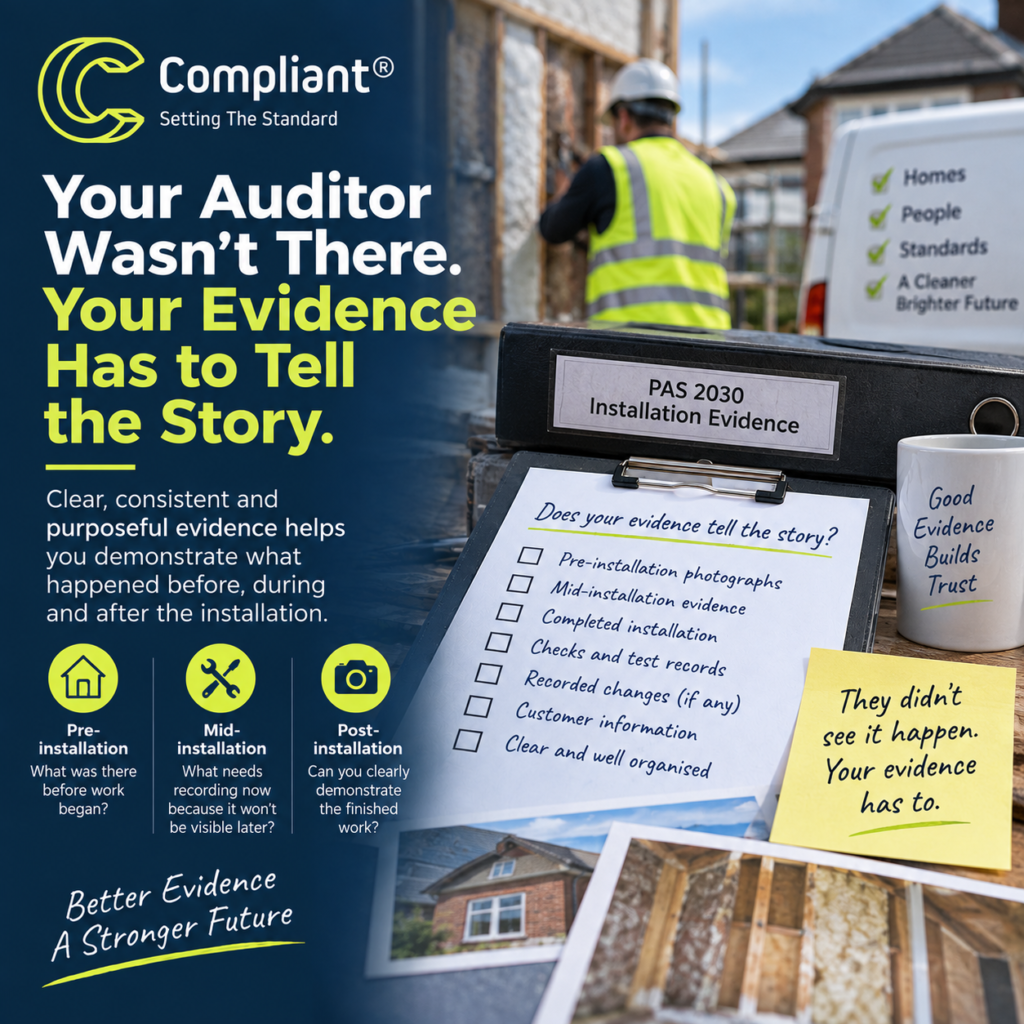

Your Auditor Wasn’t There. Your Evidence Has to Tell the Story.
Imagine an auditor opens one of your installation files.
They were not at the property.
They did not watch your installer work.
They did not hear the conversations that took place.
They did not see the condition of the property before work started.
They did not watch the installation develop.
And they cannot see the parts of the work that are now covered or hidden.
All they have is your evidence.
So, what story does it tell?
Does it provide a clear picture of what happened before, during and after the installation?
Or does it leave the auditor asking questions?
“What am I looking at?”
“When was this taken?”
“What happened between these two stages?”
“How do I know this check was completed?”
“Where is the evidence?”
This is one of the most important things for businesses working with PAS 2030 to understand.
Good evidence is not simply about having photographs.
It is not about filling folders.
And it is certainly not about collecting as many documents as possible before an assessment.
Evidence has a job to do.
It needs to demonstrate what happened when the person reviewing the installation was not there to see it.
Your evidence needs to tell the story.
The Auditor Cannot See What Your Installer Saw
Your installer has an advantage.
They were there.
They saw the property.
They could look closely at the areas where work was taking place.
They saw each stage of the installation.
They understood what they were doing and why.
Months later, that knowledge may still seem obvious to them.
But it is not obvious to somebody else.
Imagine showing an auditor a close-up photograph of part of an installation.
Your installer immediately knows what it is.
They remember taking the photograph.
They know exactly where it was.
The auditor does not.
Without context, the photograph may prove very little.
This is where businesses sometimes confuse having evidence with having useful evidence.
They are not the same thing.
A Photograph Is Only Useful If It Demonstrates Something
Modern phones have made evidence collection easier than ever.
An installer can take dozens of photographs in seconds.
That sounds ideal.
But more photographs do not automatically create stronger evidence.
You could have 100 photographs from an installation and still fail to demonstrate something important.
Why?
Because evidence needs purpose.
Before taking a photograph, think:
What am I trying to show?
That question changes everything.
Instead of randomly photographing the job, the installer begins thinking about what another person will need to understand later.
A useful photograph may demonstrate the condition before work started.
Another might capture a stage that will eventually be hidden.
Another can show the completed installation.
Together, they build a story.
Random photographs create a gallery.
Purposeful photographs create evidence.
Think Pre, Mid and Post
A simple way to improve installation evidence is to think about three stages:
Pre-installation.
Mid-installation.
Post-installation.
Each has a different job.
Pre-installation evidence helps establish the starting point.
Mid-installation evidence captures the work as it develops, including details that may later disappear from view.
Post-installation evidence demonstrates the finished result.
Together, these stages help create a much clearer picture.
If you only photograph the finished work, there may be important parts of the installation that nobody can verify afterwards.
Once something has been covered, enclosed or otherwise hidden, the opportunity to photograph it may have disappeared.
That is why evidence collection needs to happen during the work, not afterwards.
Pre-Installation Evidence Sets the Scene
Every good story needs a beginning.
Your installation evidence is no different.
Pre-installation evidence provides context.
What did the relevant area look like before work began?
Were there existing conditions worth recording?
Where was the work going to take place?
Was there anything unusual?
What information may help somebody understand the decisions made later?
The exact evidence required will depend on the measure and the installation.
The principle is what matters here.
Your pre-installation evidence should help somebody who was not at the property understand the starting position.
Do not assume they already know.
Show them.
Mid-Installation Evidence Is Often the Evidence You Cannot Replace
This is where many evidence problems begin.
The team starts work.
Everyone is busy.
Progress is good.
Then the installation is completed.
Someone asks:
“Did we photograph that before it was covered?”
Silence.
The finished installation may look excellent.
But an important opportunity has gone.
Mid-installation evidence can be some of the most valuable evidence you collect because it captures things that may not be visible later.
That makes timing essential.
You cannot always return next week and recreate it.
You certainly should not be opening completed work simply because somebody forgot to take a photograph.
Your process should therefore tell installers when evidence is required, not simply what evidence is required.
Post-Installation Evidence Completes the Story
The final stage should show the finished result.
Again, do not just take one quick photograph because everyone wants to leave.
Look at the image.
Does it clearly show what you intended?
Is the lighting good enough?
Can the viewer understand what they are looking at?
Is there enough context?
Would another photograph from a different position provide useful information?
This does not mean turning every job into a professional photography session.
It means taking a few extra seconds to make sure the evidence is useful.
Because once the team leaves, fixing poor evidence becomes much harder.
Your Auditor Should Not Need to Guess
Guessing is the enemy of good evidence.
If somebody looking at a job file has to guess what happened, something may be missing.
They should not need to guess which property a photograph belongs to.
They should not need to guess which stage of the installation it shows.
They should not need to guess whether a required check happened.
They should not need to guess why something changed.
They should not need to guess whether a problem was resolved.
Your evidence should answer questions rather than create them.
That does not mean every installation file needs to contain hundreds of pages.
Quite the opposite.
Clear evidence can often be simpler.
Quality Beats Quantity
There is a strange comfort in numbers.
“We’ve got 87 photographs from that job.”
It sounds impressive.
But what if 30 are nearly identical?
What if 15 are blurred?
What if several show somebody’s tools rather than the installation?
What if the one important stage is missing?
Now the number 87 means very little.
Evidence should be judged by what it demonstrates.
A smaller number of clear, relevant and well-timed photographs can be much stronger.
Ask your team to stop measuring evidence by volume.
Measure it by usefulness.
Context Makes Photographs Stronger
Close-up photographs can be useful.
They can capture important detail.
But sometimes they create another problem.
You can see the detail but have no idea where it is.
A simple solution is to think in pairs.
Take a wider photograph to provide context.
Then take a closer image to show the detail.
Now the person reviewing the evidence can understand both where something is and what you want them to see.
This small habit can make installation evidence far easier to understand.
Evidence Is More Than Photographs
Photographs receive a lot of attention because they are visual.
But PAS 2030 evidence is broader than photographs alone.
Your records may need to demonstrate decisions, checks, competence, materials, installation activity, problems and other relevant parts of the process.
The important question remains the same:
What does this record demonstrate?
A completed form is not automatically useful evidence simply because every box contains something.
Does the information make sense?
Does it relate to the correct job?
Was it completed at the appropriate time?
Can another person understand it?
Does it support what the other evidence shows?
Strong evidence works together.
Your Records Should Agree With Each Other
Imagine the paperwork says one thing.
The photographs appear to show something else.
Now the auditor has questions.
Perhaps there is a perfectly reasonable explanation.
But the job file should make that explanation clear.
Evidence becomes stronger when different records support the same story.
The documents identify what was planned.
The photographs show what happened.
Checks demonstrate important stages were considered.
Any changes are recorded.
The final evidence demonstrates completion.
Everything connects.
That is much stronger than a collection of unrelated files saved in the same folder.
Record Changes When They Happen
Retrofit does not always go exactly according to plan.
Existing buildings can reveal surprises.
Conditions may be different from what was expected.
Something may need changing.
The important thing is how that change is managed.
If an installation changes from what was originally planned, your evidence should make the reason clear where appropriate.
Do not allow the only record of an important decision to be:
“Steve spoke to Dave about it.”
What happens when Steve cannot remember?
What if Dave leaves?
What if the audit happens nine months later?
Record the relevant information when the decision is made.
That gives the business something much stronger than memory.
Evidence Should Show Problems Too
There can be a temptation to create a perfect-looking job file.
Only the best photographs.
Only the cleanest records.
No problems.
No changes.
No mistakes.
But real work does not always happen like that.
Something unexpected can occur.
A problem may be identified.
The important point is what happened next.
Good evidence can demonstrate that a problem was recognised, considered and dealt with properly.
That can tell a much stronger story than pretending nothing ever goes wrong.
Compliance is not about creating the appearance of perfection.
It is about control.
“We Definitely Did It” Is Not Enough
This is one of the most difficult situations during an assessment.
A record is missing.
The installer is confident.
“We definitely did that.”
They probably did.
But how can you demonstrate it?
An auditor cannot travel back in time.
They cannot rely entirely on somebody’s memory.
That is why evidence matters.
The installation team may complete hundreds of jobs.
Details blur.
People leave businesses.
Staff take holidays.
Responsibilities change.
Good records mean the business does not depend on one person’s memory.
Evidence Protects Your Installer Too
Evidence is sometimes presented to installers as another compliance demand.
“Take these photographs because we need them for the audit.”
That is not the strongest message.
Explain how evidence can protect them.
Imagine somebody questions their work months later.
Without photographs or records, it can become one person’s memory against another.
With good evidence, there is a record.
This is what was there.
This is what we did.
This is how the work progressed.
This is the completed installation.
Evidence can support the installer as much as it supports the business.
Once people understand that, evidence collection can feel much more worthwhile.
Evidence Can Protect the Customer
Customers benefit too.
Good records create accountability.
They help demonstrate what happened at the property.
They can support questions later.
They can provide information if an issue needs investigating.
And they help ensure the business has considered important stages rather than simply assuming everything is fine.
Customers may never see most of your internal evidence.
They still benefit from the processes behind it.
Evidence Should Be Collected at the Right Time
Timing can make the difference between useful evidence and no evidence at all.
This is why businesses should map evidence requirements against the actual installation process.
Ask:
What needs recording before work starts?
What needs recording before it becomes hidden?
What needs recording during checks?
What needs recording at completion?
What needs recording during customer handover?
Now the evidence process follows the job.
That is far easier than asking installers to remember everything at the end of the day.
Stop Chasing Evidence Weeks Later
If your office team regularly spends Monday mornings sending messages like:
“Can you send the missing photos from last month’s job?”
there may be a process problem.
Chasing evidence is expensive.
It takes office time.
It takes installer time.
It creates frustration.
And sometimes the missing evidence cannot be recreated.
Instead, try to identify gaps quickly.
Can evidence be reviewed before the job is fully closed?
Can missing information be flagged while the team is still close to the property?
Can your system make required evidence clearer?
The earlier you identify a gap, the easier it is to address.
Your Evidence Process Should Be Easy to Follow
If installers need a 40-page manual beside them to understand which photographs to take, something may be wrong.
Compliance needs to work in the real world.
People may be working outside.
They may be wearing gloves.
Weather conditions may be difficult.
They may have several stages to manage.
Your evidence process should recognise this.
Make requirements clear.
Put them in a sensible order.
Explain why important evidence is needed.
Remove unnecessary duplication.
The easier the correct process is to follow, the more likely people are to follow it consistently.
Do Not Add Another Form Every Time Something Goes Wrong
This happens surprisingly often.
Evidence is missed.
Someone creates a new form.
Another problem happens.
Another checklist appears.
Five years later, the business has an enormous evidence pack.
And people still miss things.
More paperwork is not always the answer.
Ask why the evidence was missed.
Was the requirement unclear?
Did the installer not understand its purpose?
Was the evidence requested at the wrong stage?
Was the process too complicated?
Was nobody checking?
Fix the cause rather than automatically adding another document.
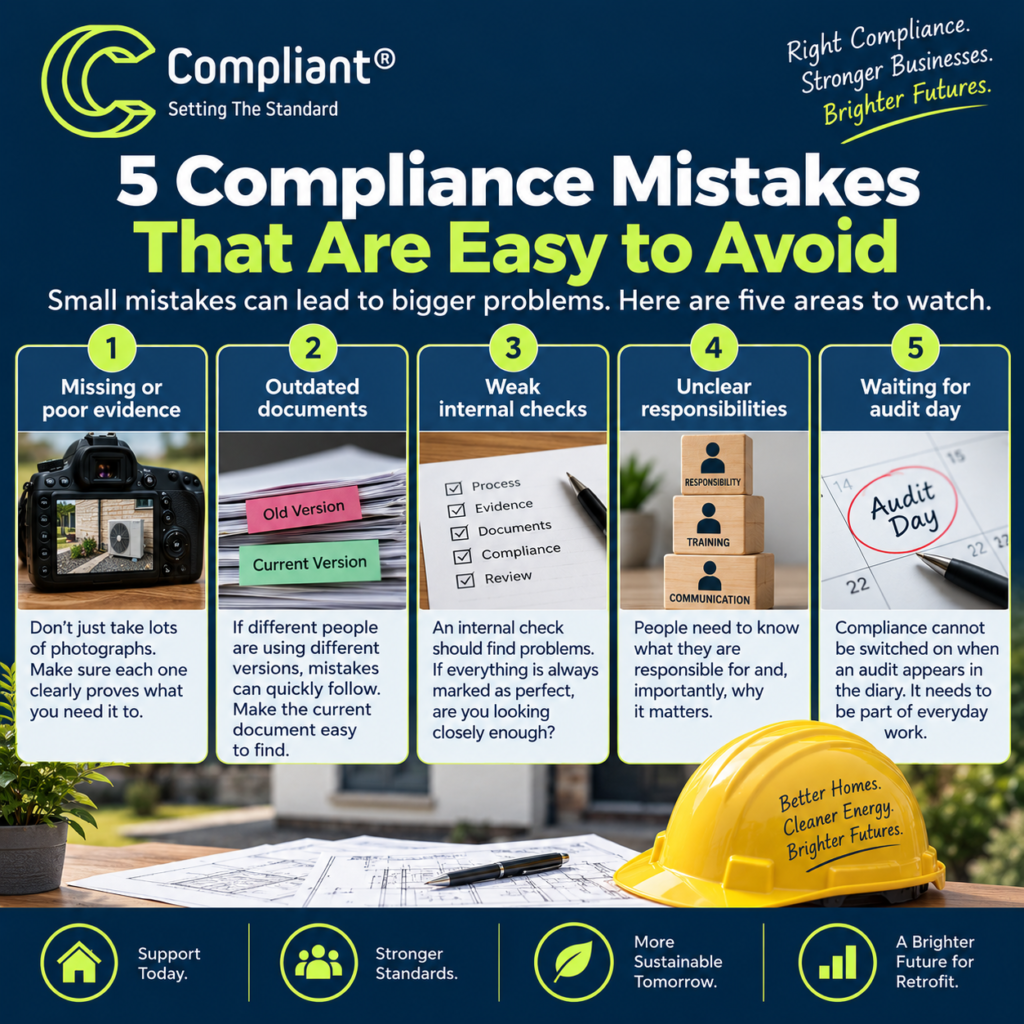
Check Evidence Before Assessment Day
You should not need an external auditor to tell you your installation evidence is weak.
Internal checks can identify this much earlier.
Choose completed jobs.
Do not always choose the best ones.
Select some randomly.
Then review them as though you know nothing about the installation.
Can you follow the story?
Can you understand what happened?
Are important stages clear?
Can you see relevant evidence from before, during and after the work?
Do the records agree?
Are changes explained?
Are there unexplained gaps?
This exercise can be extremely valuable.
The Random Job Test
Here is a useful challenge.
Ask someone who was not involved in the installation to review the file.
This is important.
The person who completed the job already knows what happened.
Their brain fills in missing information automatically.
Someone independent cannot do that.
Give them the file and ask:
“What happened on this job?”
Then listen to their questions.
Every question may point to an area where the evidence could tell the story more clearly.
Learn From Repeated Evidence Gaps
One missing photograph may be a mistake.
The same missing photograph across fifteen jobs is probably telling you something else.
Look for patterns.
Does one type of installation regularly have evidence gaps?
Is a particular stage often missed?
Do different installers misunderstand the same requirement?
Are records regularly incomplete in the same place?
Patterns are valuable.
They can reveal training needs, unclear procedures or weak processes.
Use your evidence to improve the system.
Do not simply use it to pass assessments.
Good Evidence Makes Assessment Preparation Easier
Nobody enjoys the last-minute assessment panic.
Folders are checked.
Old jobs are reopened.
People search emails.
Installers are asked for photographs.
Someone discovers half the information is on an old phone.
This is not how assessment preparation should work.
If evidence is collected, checked and stored properly throughout the year, assessment preparation becomes much easier.
The auditor asks to see a job.
You open the record.
The evidence is already there.
No reconstruction.
No chasing.
No hoping somebody remembers.
That is the goal.
PAS 2030 Compliance Should Happen Every Day
Assessment day is one day.
Your PAS 2030 processes need to work on all the others.
Evidence should not suddenly become important because an audit is booked.
The evidence exists because the work happened.
The auditor simply reviews it later.
This shift in thinking can change how businesses manage compliance.
Instead of asking:
“What will the auditor want?”
ask:
“What would somebody need to understand this job if they weren’t here?”
That question creates better evidence.
The Benefits of a PAS Consultant’s Support
Businesses can become too close to their own processes.
Your forms make sense because you have used them for years.
Your photographs look obvious because your team understands the work.
Your filing system makes sense because the same person created it.
An outside view can reveal something different.
This is where the benefits of a PAS consultant’s support can be valuable.
A PAS consultant can review sample job files without having been involved in the installation.
That puts them in a useful position.
Can they follow the evidence?
Does the file demonstrate what the business believes it demonstrates?
Are there gaps?
Is unnecessary evidence making important information harder to find?
Do written procedures match what installers actually do?
Are repeated problems being identified?
A fresh pair of eyes can expose assumptions the business no longer notices.
Consultant Support Should Explain the “Why”
Good consultant support should not simply produce a longer checklist.
It should help people understand why evidence matters.
Why is this photograph required?
What does this record demonstrate?
Why does this stage need capturing before it is hidden?
What is the risk if the evidence is missing?
Once installers understand the reason, they can make better decisions.
They stop thinking:
“I need six photos because the office says so.”
They start thinking:
“I need to demonstrate this stage because nobody will be able to see it later.”
That is a much stronger compliance culture.
A PAS Consultant Should Help Simplify Too
More evidence does not automatically mean better compliance.
A consultant may identify opportunities to make the process clearer.
Perhaps photographs are duplicated.
Maybe two forms collect the same information.
Perhaps evidence is being saved in several locations.
Maybe the checklist does not follow the order of the actual work.
Simplifying these areas can make compliance stronger.
A process that people understand and follow is better than a complicated process that looks impressive on paper but fails in practice.
The Business Needs to Own the Evidence Process
Your PAS consultant can provide support.
But your team needs to understand the process.
The installer needs to know what to record.
The office team needs to know where evidence belongs.
Managers need to understand what should be checked.
People need to recognise when something is missing.
If only the consultant understands the evidence requirements, the business remains vulnerable.
Good support should build knowledge internally.
That is one of the most important benefits of a PAS consultant’s support.
Evidence Storage Matters
Excellent evidence is not much use if nobody can find it.
Imagine you know a photograph exists.
Somewhere.
Maybe on the installer’s phone.
Possibly in an email.
Perhaps in a messaging group.
It might have been uploaded to the wrong folder.
That is not a reliable evidence system.
Your business needs a consistent approach.
Where should evidence be stored?
How is it connected to the correct job?
When should it be uploaded?
Who checks it?
How long should relevant records be kept?
What happens when somebody leaves?
The answers need to be understood by the people involved.
Do Not Depend on Personal Phones
Phones are incredibly useful for capturing evidence.
But they should not become the permanent evidence store.
Phones are lost.
They break.
People change jobs.
Images are deleted.
Storage fills up.
Evidence should move into the business’s agreed system promptly.
This also helps the business maintain appropriate control over customer and property information.
Your PAS 2030 evidence belongs with the job record, not hidden among someone’s holiday photographs.
The Story Should Make Sense Months Later
This is the ultimate test.
Imagine everyone involved in the installation has forgotten the details.
Now open the file.
Does it still make sense?
That is what good evidence achieves.
It turns a temporary event into a lasting record.
The installation happened once.
The evidence allows somebody to understand important parts of it later.
That is why evidence deserves attention.
It is not an annoying extra added to the job.
It is part of the job.
Five Questions to Ask About Every Evidence File
You can make evidence reviews much simpler by asking five questions.
1. Can I identify the job clearly?
There should be no doubt about which installation the evidence relates to.
2. Can I understand the starting point?
Relevant pre-installation evidence should provide context.
3. Can I follow important stages of the work?
Mid-installation evidence should capture details that matter.
4. Can I understand the completed installation?
Post-installation evidence should clearly demonstrate the finished result.
5. If something changed or went wrong, can I understand what happened next?
A good record should not leave unexplained gaps.
If you cannot answer one of these questions, investigate.
Evidence Is Your Installation’s Memory
People forget.
Evidence does not, provided it is clear and stored properly.
That is perhaps the simplest way to explain its value.
The installer moves on.
The customer gets on with life.
Months pass.
Hundreds of other jobs are completed.
Then somebody asks a question.
Your evidence becomes the memory of that installation.
Make sure it is a good one.
Final Thought: Your Auditor Wasn’t There
Your auditor did not stand beside your installer.
They did not watch the work.
They did not see the hidden stages.
They did not hear the conversations.
They do not know what everyone “definitely remembers doing”.
They have the evidence.
That evidence needs to speak for the installation.
It should show the starting point.
It should capture important stages.
It should demonstrate the finished work.
It should support relevant checks and decisions.
It should explain important changes.
And it should make sense without somebody standing beside the auditor explaining every photograph.
That is what good PAS 2030 evidence looks like.
Not more paperwork.
Not hundreds of random photographs.
A clear, useful and truthful record of what happened.
And when your evidence tells that story properly, assessment becomes easier too.
Because you are no longer asking the auditor to trust that the right thing happened.
You can show them.
Value CTA: Let Someone Else Read the Story
This week, choose one completed PAS 2030 installation at random.
Not your best file.
Not the one everybody remembers.
Choose a normal job.
Then give the evidence to somebody who was not involved in the installation.
Do not explain it first.
Ask them:
“Can you tell me what happened on this job?”
Listen carefully to every question they ask.
“What is this photograph?”
“Where is this?”
“What happened here?”
“Why did this change?”
“Was this checked?”
Each question could be pointing towards an evidence gap.
Use those questions to improve the next installation.
And if you work with a PAS consultant, ask them to carry out the same exercise across a sample of your files. The value is not simply in finding missing evidence. It is in understanding why it was missed and improving the process behind it.
Because when assessment day arrives, your auditor will not have been there.
Your evidence will have to do the talking.
Make sure it tells the right story.