Women’s Equality Day: Building a Stronger Retrofit Industry Through Diverse Skills and Leadership

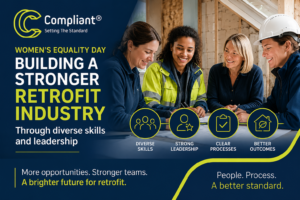
Women’s Equality Day: Building a Stronger Retrofit Industry Through Diverse Skills and Leadership
The retrofit industry has a big job to do.
Homes across the UK need to become warmer, more energy efficient and better prepared for the future. Installers need to complete work to the right standard. Businesses need to manage growing demands around quality, evidence and compliance. Customers need to feel confident that the work being carried out on their homes is safe, suitable and properly managed.
But there is another challenge that deserves just as much attention.
Where will the people, skills and leadership needed to deliver all of this come from?
If the retrofit industry wants to grow, it cannot afford to overlook talent.
It needs people with different skills, experiences, ideas and ways of thinking. It needs strong leadership at every level. And it needs businesses that give capable people the opportunity to develop, contribute and lead.
Women’s Equality Day gives us an opportunity to think about this.
Not simply because equality matters, but because building a more diverse workforce can help create a stronger retrofit sector.
For businesses working within PAS requirements, this is particularly important.
PAS compliance is not the responsibility of one person.
Good retrofit relies on people working together. Assessors, coordinators, designers, installers, administrators, managers and business leaders all play a part. When those people bring different strengths to the process, businesses can become better at spotting problems, making decisions and delivering quality work.
Diverse skills and strong leadership are therefore not separate from good retrofit.
They can be part of what makes good retrofit possible.
The Retrofit Industry Cannot Grow by Ignoring Talent
The demand for retrofit creates an enormous opportunity.
But opportunity creates pressure too.
More homes needing improvement means more assessments. More designs. More installations. More evidence. More customer communication. More quality checks. More people responsible for making sure the work follows the correct process.
Businesses cannot solve that challenge simply by asking existing teams to work harder.
There is a limit.
If the industry wants to grow properly, it needs to increase the number of skilled people entering and progressing through the sector.
That means looking at the widest possible talent pool.
A business that unintentionally puts barriers in front of women or other underrepresented groups is not simply creating an equality issue. It may also be limiting its own access to skills.
That matters when skilled people are already valuable.
Retrofit businesses need practical installation knowledge, but they also need organisation, planning, customer care, problem solving, leadership and attention to detail.
Think about everything involved in a successful retrofit project.
Someone needs to understand the property.
Someone needs to identify suitable improvements.
Someone needs to coordinate the project.
Someone needs to communicate with the household.
Someone needs to check documents.
Someone needs to record evidence.
Someone needs to manage the installation.
Someone needs to identify risks.
Someone needs to challenge decisions when something does not look right.
Someone needs to make sure the business itself has suitable systems in place.
Those are very different skills.
A strong retrofit business brings them together.
The industry therefore needs to move away from the idea that there is only one type of person who belongs in retrofit.
There isn’t.
There is room for technical experts, installers, planners, administrators, coordinators, leaders and people who are excellent at working with customers.
The wider the industry looks for talent, the stronger its future workforce can become.
Diversity Is About More Than Numbers
When businesses discuss diversity, it can quickly become a conversation about percentages.
How many women work in the company?
How many are in management?
How many are working in technical roles?
Those figures can be useful.
But numbers alone do not tell us whether a business is getting the real benefits of a diverse workforce.
A company could recruit more women while failing to give them meaningful opportunities to develop or influence decisions.
That misses the point.
Diversity becomes valuable when different people are able to contribute their skills and ideas.
Imagine a team where everyone has followed the same career path, worked in similar roles and approaches problems in roughly the same way.
That team may work well.
But it may also have blind spots.
Now imagine another team made up of people with different professional backgrounds, different life experiences and different strengths.
One person may immediately see a technical risk.
Another might notice that the customer does not understand what is happening.
Someone else might identify a weakness in the evidence being collected.
A manager may recognise that the business process itself is causing repeated mistakes.
Different perspectives can help a team see more of the whole picture.
That is valuable in Retrofit, because retrofit is rarely simple.
Every property is different.
Every household is different.
Problems are not always obvious.
Decisions made at one stage can affect work later in the project.
The industry needs people who are comfortable asking questions.
Why are we doing it this way?
Is this suitable for this property?
Have we considered the customer?
Is the evidence complete?
What happens if something goes wrong?
Have we followed the agreed process?
Those questions strengthen quality.
And businesses should want people who are confident enough to ask them.
Strong Leadership Creates Space for Better Decisions
Leadership is another important part of this conversation.
Good Leadership does not simply mean having authority.
A strong leader creates an environment where people can do their jobs properly.
That includes allowing people to raise concerns.
This is particularly important when working with PAS requirements.
A member of staff might notice that evidence is missing.
An installer might believe that the planned work is not suitable for what they have found at the property.
An administrator might spot conflicting information in documents.
A coordinator might need further information before allowing work to move forward.
What happens next depends partly on company culture.
In a weak culture, people may stay quiet.
They may worry about causing a delay.
They may assume somebody senior already knows.
They may believe questioning a decision will make them look difficult.
The project continues.
And a small concern can become a much larger problem.
Strong leaders create a different environment.
They make it clear that raising a genuine concern is part of doing the job well.
That does not mean every decision needs endless debate.
It means people should feel able to speak when something matters.
This becomes even more powerful when a business has Diverse voices within its team.
People with different experiences may notice different risks.
Good leadership makes sure those observations are heard.
Women in Retrofit Should Be Able to See a Route to Leadership
Recruitment is only one part of equality.
Progression matters too.
If women enter the retrofit sector but cannot see a realistic path towards more senior positions, the industry risks losing experienced people.
Businesses should therefore look beyond who they recruit.
They should ask who gets opportunities.
Who receives training?
Who is encouraged to gain new skills?
Who is trusted with responsibility?
Who gets involved in important conversations?
Who moves into management?
Who is being prepared to become a future leader?
These questions matter because leadership does not suddenly appear when somebody receives a new job title.
It develops over time.
People need opportunities to learn.
They need experience.
They need the chance to make decisions.
Sometimes they need support from somebody who can help them understand what their next step could look like.
This applies across the retrofit process.
Someone may begin in an administrative role and develop a deep understanding of compliance.
Another person may start in customer support and discover an interest in project coordination.
An installer might move towards supervision or management.
Someone with strong organisational skills may become increasingly involved in quality systems.
Career paths do not always need to be straight lines.
Businesses that recognise transferable skills can discover talent that might otherwise have been overlooked.
That is good for equality.
It is also sensible workforce planning.
Better Representation Can Improve Customer Experience
Retrofit ultimately takes place in people’s homes.
That point can sometimes get lost when the industry talks about standards, documents and technical requirements.
A property is not simply a project.
It is someone’s home.
People may have lived there for decades. They may be nervous about the work. They may not understand why certain measures have been recommended. They may be worried about disruption, cost or what happens if something goes wrong.
Communication therefore matters.
A great technical solution can still create a poor customer experience if nobody explains what is happening.
A Diverse workforce can help organisations develop a broader understanding of customers and their needs.
This does not mean assuming that a person will automatically understand a customer because of their gender or background.
People are individuals.
The value comes from bringing a wider range of experiences and perspectives into the organisation.
That can encourage businesses to think differently about communication.
Are instructions easy to understand?
Does the customer know who to contact?
Have concerns been taken seriously?
Has somebody explained what will happen before work starts?
Does the household understand how to use new technology or heating controls after installation?
Good retrofit is not finished simply because an installer leaves the property.
The customer needs to understand the outcome.
Leadership teams that recognise this can build customer care into the whole retrofit process rather than treating it as something that happens when a complaint is received.
Equality Does Not Mean Lowering Standards
There is an important distinction to make.
Building a more inclusive retrofit industry does not mean lowering the bar.
It should mean widening access to the opportunity to reach that bar.
Technical roles still require technical competence.
People responsible for PAS processes still need the correct knowledge and understanding.
Installers still need to carry out work properly.
Quality requirements do not disappear because a business wants to improve diversity.
Nor should they.
Instead, organisations can ask whether unnecessary barriers are stopping capable people from entering or progressing.
For example, does a role genuinely require previous experience in exactly the same job?
Or could someone with strong transferable skills be trained?
Is training available to everybody who could benefit from it?
Are development opportunities communicated openly?
Could apprenticeships help bring new people into the industry?
Could experienced members of staff mentor newer team members?
Are managers making assumptions about which employees will or will not want additional responsibility?
Small decisions can have a large effect over time.
The aim should always be competence.
But businesses can create more routes for people to develop that competence.
PAS Compliance Needs More Than Technical Knowledge
One of the common misunderstandings around PAS is that compliance is mostly about completing the installation correctly.
Installation quality is essential.
But it is only part of the picture.
The process around the work matters too.
Information needs to be accurate.
Responsibilities need to be understood.
Evidence needs to be collected.
Decisions need to be recorded.
People need to know what they are responsible for and when.
When businesses struggle with PAS compliance, the problem is not always a lack of technical ability.
Sometimes the process itself is unclear.
One person assumes somebody else is collecting evidence.
Documents are saved in different places.
Staff members are working from different versions of information.
A requirement is understood by one manager but has never been properly explained to the rest of the team.
Training happened once, but nobody has checked whether new employees understand the process.
These are leadership and management issues as much as technical ones.
This is where a broader range of skills becomes particularly useful.
The person who improves compliance may not always be the most technically experienced person in the company.
It might be someone who is excellent at organisation.
Someone who asks good questions.
Someone who can turn a complicated process into simple steps.
Someone who notices patterns in repeated mistakes.
Someone who communicates clearly.
Someone who can help different parts of the business work together.
Those skills deserve recognition.
Where a PAS Consultant Can Support the Business
As organisations grow, maintaining a clear PAS process can become difficult.
This is especially true when teams are changing.
New people join.
Existing employees move into different roles.
Responsibilities shift.
Work volumes increase.
What was once managed informally between a small number of experienced employees may no longer work.
This is one area where the support of a PAS consultant can provide value.
A good consultant should not simply arrive with a list of problems.
The aim should be to help the business understand what good practice looks like, where its current process may be weak and what practical improvements could be made.
That can include reviewing responsibilities.
Do people know what they own?
Are tasks clearly assigned?
Is one person carrying too much knowledge?
Could the process fail if a key employee was absent?
These questions are important for growing businesses.
Consultant support can also help organisations identify training needs.
Sometimes a compliance problem is really a knowledge problem.
An employee may have been asked to complete a task without being given enough information about why it matters.
Once people understand the purpose behind a process, following it can become much easier.
External support can also bring a fresh perspective.
People inside a business become used to the way things are done.
That is natural.
A process might contain unnecessary steps simply because nobody has questioned it for years.
Elsewhere, an important control might be missing because everyone assumes somebody else is dealing with it.
A consultant can help ask those questions.
The purpose should not be to take control away from the team.
Quite the opposite.
The best outcome is a business whose own people understand the PAS process well enough to manage it confidently.
PAS Support Can Help Develop Future Leaders
There is another benefit that deserves more attention.
PAS consultancy can support people, not just processes.
When knowledge is shared properly, employees can gain a stronger understanding of how their role fits into the wider retrofit journey.
That creates development opportunities.
Someone who previously completed a task because they were told to do it can begin to understand why it matters.
They start identifying risks themselves.
They ask better questions.
They become more confident.
Over time, that confidence can develop into leadership.
This is particularly valuable when businesses want to create more opportunities for women and other underrepresented groups.
Development should not be left to chance.
If someone shows ability, curiosity or strong organisational skills, give them the opportunity to learn.
Let them understand more of the process.
Include them in discussions.
Explain why decisions are being made.
Give them responsibility with suitable support.
Leadership grows when people are trusted to develop.
A consultant who works collaboratively with a business can help spread knowledge rather than allowing it to remain with only a handful of senior employees.
That makes the organisation stronger.
It also reduces reliance on individual people.
Strong Businesses Build Knowledge Across the Team
Imagine that only one person in a business truly understands its PAS responsibilities.
Everything goes through them.
Every question lands on their desk.
Every problem waits for their answer.
At first, that might seem efficient.
It isn’t.
What happens when they are on holiday?
What happens if they leave?
What happens as the company grows and one person can no longer review everything?
Knowledge held by one person creates risk.
Strong businesses build knowledge across their teams.
Not everybody needs to know everything.
But each person should understand the requirements connected to their role.
Managers should understand enough to recognise when something is going wrong.
Employees should know when a problem needs to be raised.
Senior leaders should understand their responsibilities rather than assuming compliance belongs entirely to one specialist.
This is another reason Diverse skills matter.
Compliance benefits from technical knowledge, organisation, communication, planning and leadership.
Those abilities may sit with different people.
The goal is to connect them.
Equality Should Be Part of Long-Term Workforce Planning
Women’s Equality Day is useful because it creates a moment to think.
But equality cannot be something the industry discusses for one day each year.
The real work happens afterwards.
Businesses can look at their own workforce and ask some simple questions.
Are we attracting the widest possible range of capable people?
Can employees see opportunities to develop?
Do we make training accessible?
Are women represented in decision-making roles?
Are good ideas heard regardless of who raises them?
Does our workplace culture encourage people to challenge problems?
Are we developing tomorrow’s leaders, or simply hoping they appear?
These questions do not require businesses to have all the answers today.
They require businesses to start looking.
Some improvements may be small.
A new training opportunity.
A mentoring arrangement.
A clearer job description.
Giving somebody responsibility for a project.
Inviting a wider group of employees into a process review.
Making career routes more visible.
Reviewing recruitment language.
Asking employees what is preventing them from progressing.
Small changes can build momentum.
The Retrofit Challenge Needs Everyone
The scale of the retrofit challenge means the industry cannot afford to waste talent.
We need skilled installers.
We need strong coordinators.
We need people who understand buildings.
We need people who understand customers.
We need organised administrators.
We need managers who create good systems.
We need leaders who can see the bigger picture.
And we need new people coming into the sector who can eventually take those roles forward.
That workforce should include women at every level.
Not simply because businesses want to meet a diversity target.
Because talent exists everywhere.
The businesses that recognise, develop and retain that talent put themselves in a stronger position for the future.
A more Diverse retrofit workforce can bring different perspectives into decision-making.
Strong Leadership can make sure those perspectives are heard.
Clear PAS processes can give people the structure they need to work effectively.
And the right external support can help organisations turn requirements that initially seem difficult into systems their teams understand and can follow.
These things are connected.
People.
Skills.
Leadership.
Process.
Quality.
Each strengthens the others.
Building a Stronger Retrofit Industry
Women’s Equality Day should encourage the retrofit sector to think beyond representation alone.
The bigger question is what kind of industry we want to build.
An industry where talented people can enter, learn and progress.
An industry where women can see realistic routes into technical, management and leadership positions.
An industry where asking questions is seen as a strength.
An industry where knowledge is shared.
An industry where compliance is understood across the business instead of sitting with one overwhelmed person.
And an industry where organisations recognise that the quality of their people and the quality of their processes are closely connected.
PAS requirements provide an important framework for delivering quality retrofit.
But frameworks still depend on people.
People assess homes.
People make decisions.
People carry out work.
People collect evidence.
People identify problems.
People lead businesses.
Developing those people is therefore part of building a stronger retrofit sector.
A Value-Focused Next Step
This Women’s Equality Day, use the opportunity to review more than the number of women working within your organisation.
Look at where knowledge sits.
Look at who receives development opportunities.
Look at who contributes to decisions.
Look at whether your team understands its PAS responsibilities.
Most importantly, identify the people who have the ability to become tomorrow’s retrofit leaders and ask what support they need to take the next step.
If PAS responsibilities are creating uncertainty within the business, consider using specialist PAS consultant support as an educational resource. A knowledgeable consultant can help review existing processes, highlight gaps, explain requirements in plain language and build greater understanding across the team.
The goal should not be permanent dependence on outside support.
It should be stronger internal knowledge.
Because the future of Retrofit will not be built by standards alone.
It will be built by skilled people, Diverse teams and confident Leadership working together to deliver better outcomes.