Pre, Mid and Post Installation: Why All Three Stages Matter
Pre, Mid and Post Installation: Why All Three Stages Matter
Primary keyword: PAS 2030 installation evidence
Secondary keyword/theme: Benefits of PAS consultant support
SEO Title
PAS 2030 Installation Evidence: Why Pre, Mid and Post Installation All Matter
Meta Description
Discover why pre, mid and post-installation evidence matters under PAS 2030 and how better processes can prevent missing evidence, audit issues and costly return visits.
Excerpt
A finished installation may look perfect, but does your evidence prove how it got there? Under PAS 2030, pre, mid and post-installation stages all matter. Missing just one important photograph or record can leave a gap that is difficult to fix later. Here is why businesses need to think about evidence throughout the whole installation, not just when the job is finished.
Pre, Mid and Post Installation: Why All Three Stages Matter
The installation is finished.
It looks good.
The customer is happy.
Your installer knows the work was completed correctly.
Then somebody asks a very simple question.
“Can you prove it?”
That is when a good installation can suddenly become a difficult job file.
Perhaps you have plenty of photographs of the finished work.
But nobody photographed an important detail before it was covered.
Maybe the pre-installation condition was not recorded clearly.
Or perhaps the final photographs are there, but there is no clear evidence showing what happened during the work.
The problem is that you cannot always go back and fix it.
Once something has been covered, changed or removed, the evidence opportunity may have disappeared with it.
This is why PAS 2030 installation evidence needs to be considered throughout the whole job.
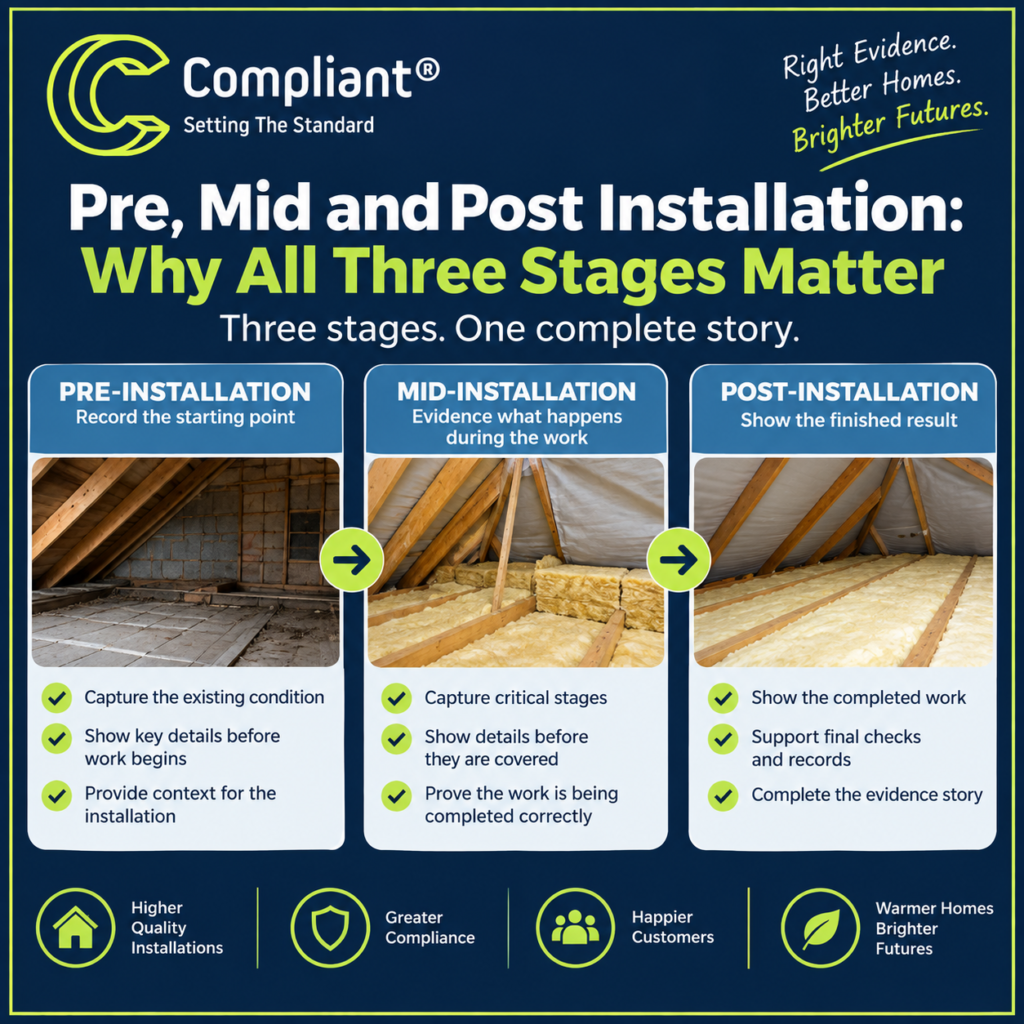
Pre-installation.
Mid-installation.
Post-installation.
All three stages tell a different part of the story.
And if one part is missing, that story can become much harder to prove.
The Finished Job Does Not Tell the Whole Story
Imagine looking at a newly decorated room.
The walls look perfect.
Everything is clean.
There is no obvious sign of a problem.
Can you tell exactly what happened behind those walls?
Probably not.
You cannot see every material used.
You cannot see every detail that was checked.
You cannot see what the area looked like before work started.
You only see the finished result.
This is one of the reasons evidence matters so much in retrofit.
An auditor was not standing beside the installer throughout the job.
The person reviewing the file may never have visited the property.
They need the records and photographs to help them understand what happened.
A photograph of the finished installation can prove something.
But it cannot necessarily prove everything.
That is why waiting until the end of the job to think about evidence is such a risk.
Good evidence starts before the work does.
Stage One: Pre-Installation
Before You Change Anything, Record What Is There
The pre-installation stage gives you something incredibly important.
A starting point.
Before work begins, there is an opportunity to record the condition of the relevant areas and information needed for the installation.
Once work starts, some of that information may disappear.
Something could be removed.
Covered.
Changed.
Or repaired.
Without clear pre-installation evidence, it may later become difficult to show what was there before the installer began.
This matters for several reasons.
It can help demonstrate that the correct checks took place.
It can provide context for decisions made during the job.
And it can help protect both the business and customer if questions are raised afterwards.
The important thing is not simply taking lots of photographs.
It is taking useful photographs.
More Photographs Do Not Automatically Mean Better Evidence
A phone containing 50 photographs of a property does not necessarily provide better evidence than a carefully chosen set of 15.
Quantity is not the goal.
Clarity is.
Every photograph should have a reason for being there.
Ask:
What does this image show?
Why do we need it?
Could somebody who was not at the property understand it?
If the answer is no, the photograph may not be doing its job.
This is a useful lesson for installation teams.
Sometimes people are told to “take plenty of pictures.”
That instruction sounds sensible.
But it is vague.
What is plenty?
Pictures of what?
At which stage?
What needs to be visible?
A better process tells people what evidence is needed and why.
That makes it easier for installers and easier for the people checking the file later.
Stage Two: Mid-Installation
This Could Be Your Only Chance to Capture the Evidence
Mid-installation evidence can be one of the easiest areas to miss.
Why?
Because this is when people are working.
The installer is focused on the installation.
Tools are being used.
Materials are moving.
The customer might have questions.
Something unexpected may have been discovered.
The team wants to keep the job moving.
Stopping to take a photograph can feel like an interruption.
But that photograph could become one of the most important pieces of evidence in the entire file.
Some details are only visible for a short period.
Once the next stage of the installation happens, they may be covered permanently.
That means the installer has one opportunity.
Miss it, and it may be impossible to recreate the evidence later without undoing completed work.
This is why mid-installation evidence cannot be left to memory.
It needs to be built into the process.
The Most Expensive Photograph Could Be the One You Forgot to Take
Consider what happens when a required photograph is missing.
At first, it might seem like a small mistake.
Then someone reviews the file.
They cannot see the evidence they need.
The installer is contacted.
Do they have another photograph?
No.
Can the information be proven another way?
Perhaps not.
Can somebody return to the property?
Maybe.
But if the important detail is now covered, returning may not solve anything.
Suddenly, one missed photograph has created phone calls, emails, extra checks and lost time.
Depending on the situation, it may create a much bigger issue.
Compare that with taking the correct photograph at the right time.
A few seconds.
That is why evidence should never be seen as something separate from the installation.
It is part of completing the job properly.
Build Evidence Into the Work
One of the simplest ways to improve mid-installation evidence is to stop relying on people remembering everything.
People forget.
Especially when they are busy.
That does not make them bad installers.
It makes them human.
A good process should support people rather than depend entirely on memory.
There might be clear stages where work stops briefly and evidence is collected before moving forward.
Installers should know:
What needs photographing.
When it needs photographing.
What the photograph needs to show.
Where it needs to be saved.
Who checks it.
This creates consistency.
It also makes training easier.
A new team member is not simply told:
“Make sure you get the PAS photos.”
They can be shown exactly what is expected.
That is far more useful.
Stage Three: Post-Installation
Finished Does Not Mean the Evidence Is Finished
The tools are packed away.
The work is complete.
Everyone is ready to leave.
This is another dangerous moment for evidence.
People are tired.
There may be another job to get to.
The customer wants to get their room back to normal.
It is easy to rush the final checks.
But the post-installation stage is the final part of the evidence story.
This is the opportunity to record the finished work clearly.
It can demonstrate the final condition and support the records showing that required checks have been completed.
But again, a photograph needs to prove something.
A blurry image taken from the doorway because someone remembered at the last second may not provide the evidence needed.
Take a little time.
Look at the photograph.
Can you see the important detail?
Is there enough light?
Is anything blocking the view?
Would another person understand what they are looking at?
Sometimes ten seconds spent checking an image can prevent hours of work later.
The Three Stages Need to Work Together
This is where the real value becomes clear.
Pre, mid and post-installation evidence should not be treated as three unrelated jobs.
Together, they tell one story.
Pre-installation: What was there before the work?
Mid-installation: What happened while the work was being carried out?
Post-installation: What was the finished result?
When those stages are properly recorded, somebody reviewing the file can follow the journey.
They do not have to guess.
They do not need the installer sitting next to them explaining what happened.
The evidence speaks for the work.
That is what businesses should aim for.
Try the Stranger Test
There is a simple exercise businesses can use when reviewing evidence.
Choose a completed job file.
Give it to someone who was not involved in the installation.
Then ask them to follow what happened.
Do not let the installer explain it.
Do not fill in the gaps.
Let the file stand on its own.
Can the person understand the journey?
Can they see what the relevant area looked like before work?
Can they follow important stages?
Can they see the finished installation?
Do the records and photographs make sense together?
Or do they need to ask:
“What happened here?”
“Where is the picture of this?”
“How do we know that was done?”
Those questions reveal gaps.
And finding those gaps internally gives you the chance to improve before somebody else finds them.
Stop Treating Evidence as an Audit Problem
One of the biggest mistakes a business can make is thinking about evidence mainly when an audit is approaching.
By then, it could be far too late.
Imagine an audit is booked for next month.
Someone starts reviewing completed files.
A job from eight months ago is missing important mid-installation evidence.
The installer vaguely remembers the property.
The customer has been living with the completed work for months.
What can you realistically do?
This is why good PAS 2030 installation evidence needs to be checked while the job is still fresh.
Ideally, evidence should be reviewed before the installation is treated as fully complete within the business’s system.
If something is missing, the business has a better chance of dealing with it quickly.
Waiting months makes everything harder.
Audit preparation should not be an exercise in rebuilding the past.
Your normal processes should keep you prepared.
Why Good Installers Can Still Have Poor Evidence
This is worth understanding.
Poor evidence does not always mean poor workmanship.
An installer can be excellent at their trade and still struggle with evidence requirements.
They may have spent years learning how to complete the physical work.
Taking photographs for audit evidence is a different skill.
They need to understand what somebody else needs to see.
This is where businesses need to educate rather than simply blame.
If an installer regularly provides poor photographs, ask why.
Have they been shown examples of good evidence?
Do they understand what each photograph is proving?
Are the instructions clear?
Are they being asked for too much unnecessary information, making the important evidence harder to identify?
Is the process practical when they are on site?
Simply saying “take better pictures” is unlikely to solve the problem.
Show people what good looks like.
Explain why it matters.
Then check that the improvement has happened.
Evidence Should Protect the Installer Too
Evidence is sometimes viewed as something collected for the auditor.
That is only part of the picture.
Good evidence can help protect the installer and the business.
Imagine a customer raises a concern several months after the work.
What happened during the installation?
What was the condition before work started?
What was completed?
If there is clear evidence, the business has information to review.
Without it, conversations may depend on memory.
And memory becomes less reliable with time.
The installer may have completed dozens of other properties since then.
Clear records create a much stronger starting point.
That is valuable even if an audit never looks at that particular job.
Small Evidence Gaps Can Reveal Bigger Process Problems
One missing photograph might simply be a mistake.
But ten jobs missing the same photograph?
That suggests something else.
Perhaps the process is unclear.
Maybe the installation team does not understand the requirement.
Maybe training is needed.
Perhaps the checklist is not working.
This is why businesses should look for patterns rather than fixing each problem separately.
If you find a missing piece of evidence, correct what you can.
Then ask:
Why did this happen?
And:
Could it happen on another job?
That second question is important.
A good system does not just fix today’s problem.
It tries to stop tomorrow’s.
Internal Checks Should Happen Before the Auditor Arrives
Internal checks are one of the most useful ways to find evidence problems.
You do not need to wait for an external audit.
Regularly select jobs and review them.
Look at the whole journey.
Check the pre-installation evidence.
Check what was captured during the work.
Review the final evidence.
Look at the supporting records.
Then record what you found.
If everything is good, that gives you confidence.
If something is wrong, you have learned something useful.
Internal checks should not be about trying to catch staff out.
They should help the business understand whether its processes actually work.
There is a big difference.
When staff see checks only as criticism, people can become defensive.
When they understand that the aim is to prevent problems, checks become much more useful.
Why PAS Consultant Support Can Help
For businesses working under PAS 2030, knowing exactly what is expected can sometimes feel difficult.
There are requirements to understand.
Evidence to manage.
Processes to maintain.
Staff to support.
Internal checks to complete.
And external audits to prepare for.
All of this has to happen while the business is still doing its normal work.
This is where the benefits of PAS consultant support can become particularly useful.
Good consultant support should help businesses understand what evidence is needed and why.
It can provide another pair of eyes.
Perhaps your team believes its evidence is strong.
A consultant reviewing sample files may notice that one stage is regularly weak.
That gives you an opportunity to act.
Training can be improved.
Instructions can be made clearer.
Checks can be changed.
The problem can be dealt with before it spreads across more installations.
But there is an important point.
Consultant support should not mean the consultant becomes the only person who understands PAS.
That creates dependence.
Good support should build knowledge inside the business.
Your Team Should Understand the “Why”
Imagine two installers.
The first is told:
“You need eight photographs for this job.”
The second is told what each photograph needs to demonstrate and why it matters.
Who is more likely to collect useful evidence?
Probably the second.
Numbers alone do not create understanding.
Education does.
This is where a PAS consultant can support managers and teams by helping turn requirements into clear working practices.
The goal should be for staff to understand what they are doing.
Then, if something unexpected happens on site, they are better placed to make a sensible decision.
They are not blindly following a checklist.
They understand the purpose behind it.
Good Evidence Can Make Audit Preparation Less Stressful
Nobody wants the weeks before an audit to become a search operation.
“Who has the photos from this job?”
“Where is that document?”
“Can anyone remember what happened here?”
“Was this checked?”
“Why is this file empty?”
That pressure usually has a cause.
The evidence was not controlled properly when the work happened.
When pre, mid and post-installation evidence is collected and reviewed as part of every job, audit preparation becomes much simpler.
You are not trying to create evidence.
You are reviewing evidence that already exists.
There is a huge difference.
An audit then becomes an opportunity to demonstrate the way your business normally works rather than a deadline that changes the way everyone behaves.
Do Not Aim for Perfect Files Only When Someone Is Looking
There is little value in having five perfect files for an audit if the other 100 jobs completed that year have serious gaps.
Quality needs to be normal.
That does not mean every job will be perfect.
Mistakes happen.
What matters is having a system that spots them.
A missing photograph should lead to a question.
A repeated problem should lead to action.
An unclear process should be improved.
Staff who need support should receive it.
This creates a culture where evidence becomes part of quality rather than an annoying extra task.
And that is where PAS starts becoming part of everyday business rather than something kept in a folder for audit day.
Review One Installation Today
If you want to understand how well your evidence process is working, you do not need to start with a huge review.
Start with one job.
Choose a recently completed installation.
Then look at it in three sections.
Pre-installation
Can you clearly understand the starting point?
Is the relevant condition recorded?
Does the evidence support what happened next?
Mid-installation
Can you see the important stages of the work?
Has evidence been captured before important details were covered?
Do the photographs actually prove what they are supposed to prove?
Post-installation
Can you clearly see the completed work?
Are final checks recorded?
Does the evidence provide a clear ending to the installation story?
Then step back.
Look at the whole file.
Does it tell a complete story without somebody having to explain it?
If not, you have found an opportunity to improve.
Three Stages. One Complete Story.
Pre, mid and post-installation evidence should never be treated as three boxes that simply need ticking.
Each stage has a purpose.
Before the work, you establish the starting point.
During the work, you capture details that may never be visible again.
Afterwards, you demonstrate the finished result.
Miss one stage and you may create a gap that cannot easily be filled later.
Get all three right and your evidence becomes much stronger.
It supports your audit preparation.
It helps your managers review work.
It gives installers a clearer process.
It can protect the business if questions arise.
And it provides greater confidence that the installation has been completed in line with the required process.
The lesson is simple.
Do not wait until the installation is finished to start proving that it was done properly.
Build evidence into the job from the beginning.
Teach your teams what each photograph and record needs to show.
Review evidence while the work is still fresh.
Use internal checks to find patterns.
And if you have PAS consultant support, use that knowledge to understand your weaknesses and strengthen your own team.
The best time to discover that a photograph is missing is while there is still an opportunity to take it.
Not six months later.
Not the week before an audit.
And certainly not while an auditor is sitting in front of you asking to see it.
Pre. Mid. Post.
Three stages.
One installation.
And one clear story that your evidence should be able to tell from beginning to end.