PAS 2030: The Installation Is Finished. But Is the Evidence?


The Van Has Left. Is the Job Really Finished?
The installer has packed away the tools.
The work looks good.
The customer is happy.
The team moves on to the next property.
Job complete?
Not necessarily.
A few days later, someone in the office starts reviewing the file.
There should be a photograph showing an important stage of the installation.
It isn’t there.
Another photo exists, but it is too dark to see what matters.
A record has not been fully completed.
Someone needs to know what happened at a certain point during the work, but there is nothing in the file that clearly explains it.
So the installer gets a phone call.
“Do you remember that property from last week?”
Perhaps they do.
Perhaps they have completed another ten installations since then.
Maybe the missing information can be found.
But what happens if the evidence relates to work that has now been covered?
You cannot simply take another photograph.
What if the installer cannot remember exactly what happened?
What if the evidence cannot be recreated?
This is why businesses working to PAS 2030 need to challenge a very simple idea:
The physical installation being finished does not automatically mean the job is finished.
The evidence needs to be finished too.
And the best time to create that evidence is while the work is actually happening.
Evidence Should Not Be an End-of-Job Task
One of the easiest mistakes to make is separating installation from compliance.
The installation team completes the work.
Then someone deals with the evidence.
This might sound efficient.
In practice, it can create unnecessary problems.
Good PAS 2030 evidence is connected directly to what happens at the property.
Some evidence is needed before work starts.
Some can only be captured while the installation is taking place.
Other evidence is created when the work is complete.
If everything is left until the end, opportunities can disappear.
Think about a stage of work that will eventually be hidden.
While the installer is working, it is visible.
A clear photograph could be taken in seconds.
Then the next stage begins.
The work is covered.
Now that evidence cannot easily be recreated.
This is why evidence should move through the job alongside the installation.
It should not be a separate task waiting at the finish line.
Why Does PAS 2030 Evidence Matter?
Evidence helps create a clear record of what happened.
That matters because the person reviewing the installation later was probably not standing beside the installer.
They did not see the work being carried out.
They cannot rely on the installer’s memory.
They have the job records.
Those records need to make sense.
Good installation evidence helps answer important questions about the work and supports the wider compliance process.
It can show the condition before work started.
It can record important stages during installation.
It can demonstrate the completed result.
It can support records of checks and decisions made during the job.
Most importantly, it helps somebody who was not there understand what happened.
That should be the test for your evidence.
Not:
“Have we got some photos?”
But:
“Could someone who wasn’t on site understand this installation from the evidence we have collected?”
Those are very different questions.
The Evidence Should Tell a Story
Think of a PAS 2030 job file as the story of an installation.
Every piece of evidence contributes to that story.
The information gathered before work begins sets the scene.
Pre-installation photographs show the starting point.
Mid-installation evidence records important stages as the work progresses.
Post-installation photographs show the completed result.
Records explain decisions and checks.
Together, these create a clear journey.
But imagine opening a book and finding several pages missing.
You may understand some of what happened.
You might even be able to guess what happened between two sections.
But guessing is not the same as having a complete record.
The same applies to retrofit evidence.
A folder containing lots of information is not automatically a strong evidence file.
What matters is whether the important stages are clear.
Pre, Mid and Post Installation Evidence
One useful way to manage evidence is to think about three stages.
Pre-installation
What was there before work started?
Pre-installation evidence helps provide context.
Depending on the work involved, this can include relevant conditions at the property and areas where installation work will take place.
These photographs and records establish the starting point.
Without them, somebody reviewing the file later may only see the completed result.
That makes it harder to understand the full journey.
Mid-installation
This stage deserves particular attention.
Why?
Because some of the most important evidence may only be available for a short time.
Work that is clearly visible at 11am could be completely covered by lunchtime.
Once that happens, the opportunity to photograph it has gone.
This is why installers need to understand which stages require evidence before they reach them.
If the process relies on somebody remembering at the last second, there is a greater chance of gaps.
Post-installation
Once the work is complete, photographs can show the finished result.
This is important.
But post-installation photos cannot always replace evidence that should have been collected earlier.
A beautiful photograph of a finished surface tells you what the customer can see.
It may tell you very little about the work underneath.
That is why all three stages need to work together.
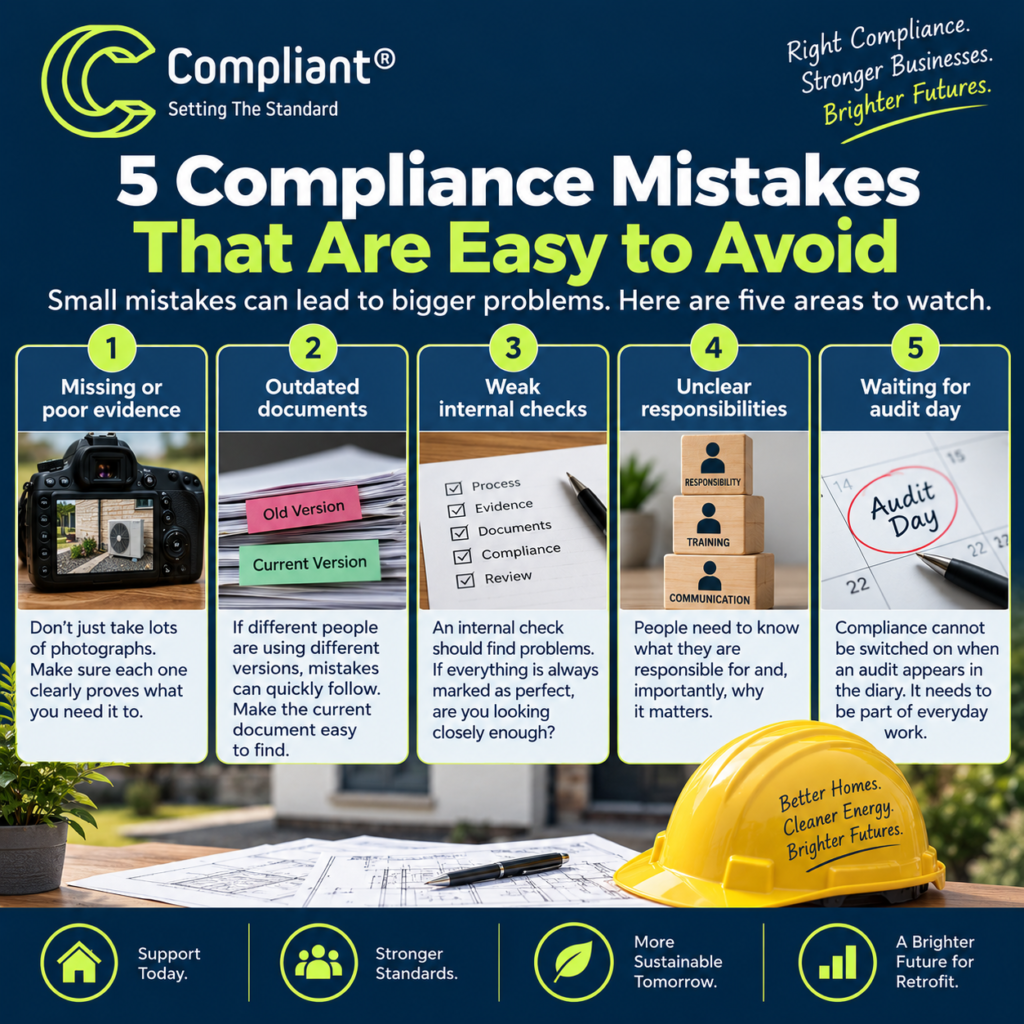
More Photos Do Not Automatically Mean Better Evidence
There can be a temptation to solve evidence problems by telling installers:
“Take loads of photos.”
That is not necessarily the answer.
You could have 200 photographs and still be missing the one that matters.
Good evidence is about quality and purpose.
Every important photograph should answer a question or demonstrate something useful.
A photograph that is dark, blurry or taken from too far away may add very little.
Likewise, ten almost identical pictures may not be as useful as one clear image taken at the right stage.
Before moving on, installers should consider:
Is the photograph clear?
Does it show the intended detail?
Is there enough context to understand what we are looking at?
Can it be linked to the correct job?
Is this the right stage of the installation?
Would somebody who was not here understand why this picture matters?
These simple checks can make a major difference.
Take It. Check It. Then Move On.
This is one of the simplest habits a business can introduce.
Do not just take the photo.
Check it.
A photograph may look fine while someone is quickly taking it.
When reviewed later on a larger screen, the important detail may be blurred.
The lighting might be poor.
Something could be blocking the view.
If the installer checks immediately, they can take another photograph.
That opportunity may disappear five minutes later.
A simple process can help:
Take it. Check it. Then move on.
It takes seconds.
Compare that with the time spent trying to fix the problem later.
Someone in the office notices the issue.
They contact the installer.
The installer looks through their phone.
Another team member becomes involved.
Someone checks other records.
Perhaps a return visit is discussed.
All because a photograph was not checked when it was taken.
Good compliance does not always require complicated solutions.
Sometimes it requires better habits.
Evidence Should Be Easy to Find
Taking good photographs is only half the problem.
Where do they go?
Imagine an installer captures every required image perfectly.
Then the photos are saved with hundreds of other pictures.
Nobody knows which image belongs to which property.
Or the evidence is stored in several different places.
Some is on a phone.
Some is in an email.
Some is uploaded to the job file.
A few photographs are sent through messages.
Technically, the evidence may exist.
Practically, finding it becomes difficult.
Good PAS 2030 compliance requires businesses to think about how evidence is managed after it is created.
There should be a clear process.
Where does evidence go?
Who is responsible for uploading it?
How is it connected to the correct job?
How does somebody know what each photograph shows?
When should the file be checked?
The simpler and clearer this process is, the easier it is for people to follow.
Do Not Let the Office Become an Evidence Rescue Team
This is a common problem.
The installation team completes the work.
Then the office team receives the job file and starts finding gaps.
They send emails.
They make calls.
They chase photographs.
They ask questions.
Eventually, most of the file may be completed.
But this is a very inefficient way to manage PAS 2030 evidence.
The office team cannot photograph something that has already been covered.
They cannot always know what happened at the property.
They can only work with the information that was captured.
This creates frustration on both sides.
The office wonders why evidence is missing.
The installer wonders why they are constantly being contacted about old jobs.
Neither group is necessarily the problem.
The process is.
A stronger system moves evidence collection to the point where the evidence actually exists.
The office can then check and manage the records rather than trying to recreate them.
Do Not Wait for an Assessment to Find the Gaps
There is a particularly bad time to discover weak evidence.
When somebody else asks to see it.
By that stage, the installation could be months old.
People’s memories have faded.
The customer may need to be contacted again.
The work may be completely hidden.
That is why audit readiness should not mean preparing everything just before an assessment.
A business should aim to have job files that are complete and understandable as part of normal operations.
An assessment should not cause a sudden rush to find evidence.
The evidence should already be there.
This is easier when businesses review files regularly.
Do not wait months.
Check completed jobs.
Look for patterns.
Are the same photos regularly missing?
Are records incomplete in the same places?
Is one team struggling more than another?
Are subcontractors clear about expectations?
Does evidence arrive late?
Each pattern gives management useful information.
A Missing Photo May Be a Process Problem
Suppose one installer misses one photograph.
That could simply be a mistake.
People make mistakes.
But what if five installers keep missing the same photograph?
That is different.
Now you need to look at the process.
Perhaps the requirement is unclear.
Maybe installers do not understand why that photograph matters.
Perhaps the instruction appears at the wrong point in the job.
Maybe the system makes uploading evidence difficult.
Simply telling everyone:
“Remember to take the photo”
may not solve the problem.
Find out why it keeps happening.
Good compliance management does not only correct mistakes.
It learns from them.
Evidence Expectations Need to Be Clear
Never assume everyone understands what “good evidence” looks like.
An experienced installer may know exactly what they need to capture.
Someone newer to the business may not.
A subcontractor may have used a completely different system elsewhere.
Even experienced teams can interpret instructions differently.
Make expectations clear.
One of the easiest ways to do this is with examples.
Show a poor photograph beside a good one.
Explain why one works and the other does not.
Show what needs to be visible.
Explain when the image should be taken.
Keep the guidance practical.
The aim is not to turn installers into professional photographers.
They simply need to understand how to create useful evidence.
Training Should Explain Why
There is a difference between telling someone what to do and helping them understand why they are doing it.
Imagine telling an installer:
“You need to photograph this stage.”
They may remember.
Now explain:
“You need to photograph this stage because it will be covered shortly. If we miss it now, we may not be able to evidence it later.”
That gives the instruction meaning.
People are more likely to follow processes consistently when they understand their purpose.
Training around PAS 2030 site photos and other evidence should therefore explain the reason behind the requirement.
This also helps installers make better decisions when something unexpected happens.
They understand the purpose, not just the instruction.
Evidence Is Not Only the Installer’s Responsibility
The installer may collect much of the evidence, but management still has an important role.
Managers need to create a system that makes good evidence possible.
If installers are rushed from one property to another with no time to check records, problems are more likely.
If instructions are unclear, results will vary.
If nobody reviews completed files, weak habits can continue.
If the evidence system is difficult to use, people may find shortcuts.
Management should ask:
Are expectations clear?
Have people been trained?
Is the process practical on site?
Are completed files reviewed?
Are recurring gaps being investigated?
Does the team receive feedback?
Are subcontractors following the same approach?
Evidence quality is therefore a business issue, not simply an installer issue.
Good Evidence Can Save Time
Compliance is often seen as something that takes extra time.
Collecting evidence does take time.
But poor evidence takes time too.
Often much more.
Think about the hidden work caused by an incomplete file.
Someone notices the gap.
Someone contacts the installer.
The installer stops what they are doing to answer.
Records are searched.
Photographs are checked.
Management may become involved.
A decision has to be made about what happens next.
That can take far longer than capturing the correct evidence in the first place.
Good processes move the work to the easiest point.
Take the photograph while you are there.
Record the information while it is fresh.
Check the file before the opportunity disappears.
A few minutes during the installation can prevent hours of chasing later.
When Is a PAS 2030 Job Actually Complete?
This is a useful question for every business.
What does “job complete” mean?
Is it when the physical work ends?
When the installer leaves?
When the customer signs something?
Or when the physical work and the supporting evidence have been completed and checked?
Businesses should define this clearly.
If an installer can mark a job complete while important evidence is still missing, the system may be encouraging problems.
Consider adding a simple completion check.
Have the required records been completed?
Are the necessary photographs present?
Are they clear?
Have important changes been recorded?
Is there anything that still needs to be resolved?
Only then should the job move into the completed stage.
That creates a clear finish line.
How PAS Consultant Support Can Help
Sometimes a business knows it has evidence problems but struggles to understand why.
Perhaps missing photographs keep appearing.
Maybe job files are inconsistent.
Perhaps different teams follow different methods.
This is where PAS consultant support can provide value.
A consultant can help businesses review the journey of evidence from the beginning of a job to the end.
The focus should not simply be on whether documents exist.
It should be on whether the process works.
Does the written procedure match what happens on site?
Do installers understand what is expected?
Are evidence requirements practical?
Are files checked early enough?
Where do gaps repeatedly appear?
Could the process be made simpler?
The aim should not be to create more forms.
It should be to make compliance easier to manage consistently.
External support can also provide a fresh view.
When people use the same process every day, they naturally become used to it.
A confusing step can start to feel normal.
Someone looking at the process from outside may spot opportunities for improvement that internal teams have stopped noticing.
Make Evidence Part of the Installation
The strongest approach is to stop treating evidence as a separate activity.
It is part of the job.
When the installer reaches an important stage, collecting evidence should be one of the normal steps.
Complete the work.
Record it.
Check it.
Continue.
This creates a much more natural process.
It also removes the dangerous gap between:
“We’ve finished the installation”
and:
“Now we need to sort the compliance.”
There should not be a gap.
The two should move together.
Review a Job as Though You Were Never There
Here is a useful exercise for your next internal review.
Choose one completed PAS 2030 installation.
Ideally, pick one you personally did not attend.
Open the job file.
Start at the beginning.
Do not ask the installer to explain anything yet.
Can you understand the starting point?
Can you follow the installation?
Are the important stages visible?
Do the photographs make sense?
Can you see the completed work?
Do the records support what the photographs show?
Are there unexplained gaps?
Now ask yourself:
If this was the only information available, would I understand what happened?
If not, you have found something worth improving.
Repeat the exercise with several jobs.
Patterns will start to appear.
That is where the real value lies.
The Installation Is Finished. The Evidence Should Be Too.
A finished installation feels like an obvious end point.
But for a business working to PAS 2030, there is another question to answer.
Is the evidence finished?
If the answer is no, the job is not as complete as it appears.
Do not wait until somebody asks for proof.
Do not rely on installers remembering old jobs.
Do not assume hundreds of photographs automatically mean good evidence.
Build the evidence alongside the work.
Plan what needs to be recorded.
Capture pre, mid and post installation stages.
Check photographs before moving on.
Keep records organised.
Review completed files.
Learn from recurring gaps.
And make sure everyone understands their role.
Good PAS 2030 evidence should tell the story of the installation without requiring somebody to stand beside the file and explain what happened.
When that becomes normal practice, assessment preparation becomes easier too.
Not because the business suddenly starts preparing for compliance.
Because the evidence was created properly in the first place.
Value-Focused CTA
Before you close your next PAS 2030 job, try one final check.
Imagine the installer is unavailable and somebody who has never visited the property needs to understand exactly what happened.
Open the evidence and follow the installation from beginning to end.
Can you see the starting point?
Can you understand the important stages?
Can you see the finished result?
Are the records clear?
If the evidence leaves you asking questions, do not simply fill the gap and move on.
Ask why that gap appeared.
Then improve the process so the next job tells the complete story from the start.
Because the best time to complete your PAS 2030 evidence is not when somebody asks to see it.
It is while the installation is still happening.