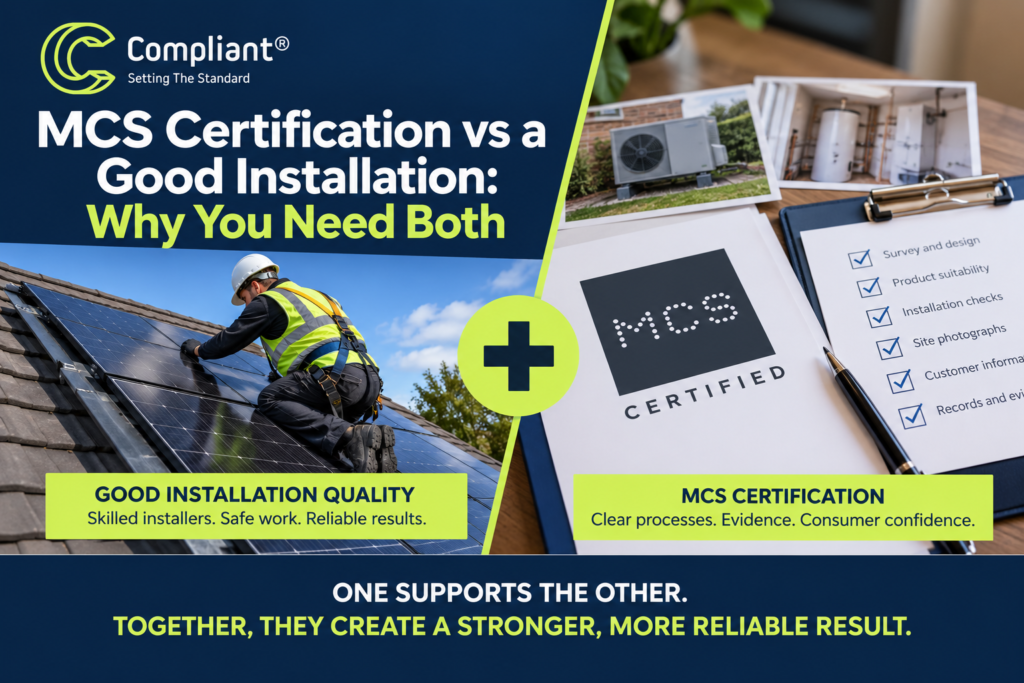
MCS Certification vs a Good Installation: Why You Need Both

A Good Installation Is Not the Whole Job
The solar panels look perfect.
The heat pump is working.
The customer is happy.
So the job is finished, right?
Not quite.
For an MCS certified business, completing a good physical installation is only part of the job.
You also need the processes, records and evidence that support it.
This is where businesses can sometimes run into trouble.
An experienced installer may look at a completed job and know that it has been done well. They can see the quality of the work. They know the products used, how the system was fitted and the checks that took place.
But somebody reviewing that installation later was not standing beside them.
They need evidence.
At the same time, a business could have organised paperwork, completed forms and detailed records, but none of that makes up for poor workmanship.
That is why the choice should never be:
MCS certification or a good installation?
You need both.
One supports the other.
Together, they help create a clear, consistent process that gives customers greater confidence in the work being carried out.
What Does MCS Certification Add to a Good Installation?
A good installer cares about workmanship.
That matters enormously.
But MCS certification is about more than whether the finished system looks good.
It provides a framework around how certified businesses work.
That means considering the wider journey, not simply the physical work completed at the property.
Think about everything that happens around an installation.
There is the initial customer contact.
There may be surveys and assessments.
The system needs to be designed appropriately.
Products and materials need to be considered.
The installation itself takes place.
Checks are completed.
Evidence is collected.
Information is provided to the customer.
Records are retained.
All of those stages matter.
When these processes are managed well, the business is not simply relying on individual people remembering what to do.
There is a consistent way of working.
That is important because even the best installer can make mistakes.
People get busy.
Teams change.
New employees join.
Subcontractors may be involved.
Workloads increase.
A process gives people something clear to follow.
“But We Know How to Install It Properly”
This is an understandable response.
A business may have experienced installers who have worked in the sector for years.
They know their trade.
So why do they need processes telling them what to do?
Because technical ability and a controlled business process are not the same thing.
Imagine you have five installers.
All five may be very good at their jobs.
But do they all approach every stage in exactly the same way?
Do they collect the same evidence?
Do they carry out and record the same checks?
Do they give customers the right information?
Do they store job records consistently?
Do they know what needs to happen if something changes during an installation?
Without a clear process, you can end up with five different ways of doing the same job.
The physical installations might still be good.
But inconsistency creates risk.
And as a business grows, that risk can grow with it.
MCS processes help businesses move away from relying solely on individual knowledge.
Good knowledge still matters.
Experience still matters.
Skill absolutely matters.
But the business also needs a system that supports those people.
Paperwork Cannot Rescue Poor Workmanship
There is another side to this.
Sometimes businesses can become so focused on records that the paperwork begins to feel like the main goal.
It is not.
A beautifully organised job file cannot turn a poor installation into a good one.
Forms do not replace skill.
Photos do not replace good workmanship.
A checklist does not mean much if somebody simply ticks boxes without carrying out the required checks properly.
The purpose of records is to support what actually happened.
They should provide a clear account of the work.
This is why the physical installation and the MCS process cannot be separated.
The paperwork should reflect the job.
The evidence should support the work.
The checks should mean something.
And the installation itself needs to meet the required standard.
When all of those pieces work together, the result is much stronger.
The Customer Cannot See Everything
This point is easy to overlook.
Customers can see some parts of their renewable energy installation.
They can see solar panels on a roof.
They can see a heat pump outside the property.
They may be able to see controls and other equipment.
But there is a lot they cannot see.
They may not know whether the system was designed correctly.
They may not understand all the technical checks involved.
They are unlikely to have watched every stage of the installation.
Some parts of the work may eventually be hidden.
So how does the customer gain confidence?
Part of that comes from the quality of the finished work and the way the installer behaves.
Part comes from having a recognised process around that work.
That is where MCS certification has an important role.
Certification does not mean that nothing can ever go wrong.
No system can promise that.
Instead, it provides a framework within which certified businesses are expected to operate.
For a customer, that wider structure matters.
Good Evidence Connects the Two
Evidence is where installation quality and MCS compliance often meet.
Imagine a job has been completed perfectly.
Weeks later, somebody asks to see evidence of a particular stage.
The installer remembers doing it.
The team knows it was done.
But there is no photograph.
There is no clear record.
Perhaps the relevant part of the installation is now hidden.
You have a good installation but a weak evidence trail.
Now imagine the opposite.
There are dozens of photographs.
Every document has been saved.
Forms are complete.
But the photographs show poor work.
You have lots of evidence, but it is evidence of a problem.
Neither position is where you want to be.
Good evidence should show good work.
That sounds obvious, but it is an important principle.
Your evidence should tell the story of the installation.
Someone reviewing the job later should be able to understand what happened without relying entirely on the memory of the person who carried it out.
A Good Installation Starts Before Installation Day
Installation quality does not begin when somebody arrives with their tools.
Decisions made before work starts can have a major effect on what happens later.
The right information needs to be gathered.
The property needs to be properly considered.
The proposed system needs to be suitable.
Potential issues need to be identified.
The team needs the information required to complete the work correctly.
If those earlier stages are weak, the installer may arrive on site already facing problems.
Perhaps information is missing.
Perhaps the reality of the property does not match what was expected.
Perhaps the planned work needs to change.
Good MCS installation practices therefore need to consider the whole journey.
The physical installation is a major part of that journey, but it does not sit on its own.
Planning supports installation.
Installation supports commissioning.
Evidence supports the record.
Handover supports the customer.
Each stage affects the next.
Consistency Matters as Much as the Best Job You Have Ever Done
Most businesses can point to an installation they are particularly proud of.
Everything went smoothly.
The workmanship was excellent.
The records were complete.
The customer was delighted.
But quality is not about producing one excellent job.
It is about being able to repeat good practice.
Again.
And again.
And again.
That is where systems become valuable.
A strong process helps a business make good practice normal.
Installers know what is expected.
Managers know what needs to be checked.
New team members have guidance.
Evidence requirements are clear.
Problems can be spotted earlier.
If something does go wrong, the business has a way to investigate what happened and improve.
Without that structure, quality can depend too heavily on who happens to be carrying out the work that day.
What Happens When the Process and the Installation Become Separated?
Problems often begin when businesses treat installation and compliance as two different jobs.
The installer completes the work.
Then somebody in the office tries to make the paperwork fit afterwards.
That is a risky approach.
The person completing the records may not have been on site.
They might need to chase installers for information.
Photos may be missing.
Details may have been forgotten.
Documents can become a reconstruction of what people think happened rather than a reliable record created as the work progressed.
It also creates extra work.
Installers get phone calls asking them to remember a job they completed weeks ago.
Office staff spend time searching through files.
Managers have to resolve gaps.
Something that could have taken a few minutes at the right stage can become a much bigger task later.
A better approach is to make MCS compliance part of the job itself.
Evidence is collected when the work happens.
Checks are recorded when they take place.
Changes are documented at the time.
The job file grows alongside the installation.
Then the paperwork and the physical work tell the same story.
MCS Should Not Become a Box-Ticking Exercise
This is an important distinction.
Having a process does not automatically mean you have a good process.
A checklist can be useful.
But only if people understand why they are completing it.
If staff are simply ticking boxes because somebody told them they must, there is a danger that the purpose gets lost.
The same applies to photographs.
Taking 50 pictures does not automatically create good evidence.
Completing a form does not automatically prove that a check was meaningful.
Signing a document does not guarantee the process behind it was followed correctly.
People need to understand why each stage matters.
When they understand the reason, compliance becomes less about completing paperwork and more about protecting the quality of the work.
That is a much healthier way to approach it.
Installation Quality Protects More Than the Customer
Poor installation quality can affect the customer, but the impact can spread further.
It can create call-backs.
It can lead to complaints.
Teams may need to return to site.
Managers may spend time investigating what happened.
Jobs that should have been completed once can consume more time and resources.
There may also be an effect on the business’s reputation.
Customers talk.
Reviews are read.
People share experiences.
In a sector where trust matters, repeated quality problems can quickly become expensive.
Good installation practice helps reduce these risks.
But the MCS process also helps because it encourages businesses to look beyond the finished appearance of the job.
What was planned?
What was checked?
What evidence exists?
Was the customer given the correct information?
Were problems recorded and dealt with?
These questions help build a more complete picture of quality.
What About Experienced Installers?
Experience is valuable.
There is no substitute for people who understand their work.
But experience works best when it is supported by a good system.
Think about what happens when your most experienced installer is away.
Does the process still work?
What happens when somebody new joins?
Can they understand what is expected?
What happens if your business grows from five installers to 15?
Can you maintain the same level of consistency?
This is where documented processes become particularly important.
They allow knowledge to become part of the business rather than staying inside one person’s head.
Your experienced people can also help improve those processes.
If installers find that something does not work well in practice, listen to them.
The best systems are not built in an office and forgotten.
They improve through feedback from the people actually using them.
Management Has a Role Too
It is easy to think MCS is mainly an installer issue.
It is not.
Management plays a major part in creating the conditions for good work.
If teams are rushed from job to job, evidence may suffer.
If instructions are unclear, people may make different decisions.
If nobody reviews completed files, poor habits can continue unnoticed.
If training is treated as a one-time event, knowledge can become outdated.
Managers therefore need visibility.
They need to understand whether the process is actually working, not simply whether a procedure exists.
Look at completed jobs.
Talk to installers.
Review evidence.
Look for repeated problems.
Ask where people are struggling.
If the same issue appears several times, do not just correct it several times.
Find out why it keeps happening.
That is where improvement starts.
How MCS Consultant Support Can Help
Businesses working towards or maintaining MCS certification can sometimes become too close to their own processes.
Something may seem clear because the team has used it for years.
But a new employee may find it confusing.
A checklist may exist but no longer match what happens on site.
Evidence requirements may be understood by one installer but interpreted differently by another.
External MCS support can help businesses look at these processes with a fresh pair of eyes.
A consultant can help review how the business works in practice, not simply what its documents say.
For example, does the written process match what actually happens on site?
Are responsibilities clear?
Do installers know what evidence needs to be collected?
Are completed job files being checked?
Are recurring problems being identified?
Does the business learn from mistakes?
The value of support should be in helping the business understand its own system better.
The goal is not to create piles of extra paperwork.
It is to help make good practice easier to follow and easier to demonstrate.
Internal Checks Should Look at Both Sides
When reviewing your own MCS processes, do not focus only on paperwork.
And do not focus only on the finished installation.
Look at both.
Choose a completed job.
Start at the beginning.
Can you follow what happened?
Does the information make sense?
Is the evidence clear?
Do the photos show useful stages of the work?
Do the records match the installation?
Were checks completed and recorded?
Is there anything that would leave somebody reviewing the file with questions?
Then look at the physical work where appropriate.
Does what you see match what the records tell you?
This kind of review can reveal gaps before they become bigger issues.
It can also show where your process is working well.
That matters too.
If one team consistently produces excellent evidence, find out what they are doing differently.
Good practice should be shared.
Consumer Confidence Is Built Through the Whole Experience
A customer’s view of quality is not formed by one thing.
It begins before installation day.
Were things explained clearly?
Did people arrive when expected?
Did the customer understand what was going to happen?
Was the property treated with care?
Was the work completed well?
Were questions answered?
Did the customer receive the information they needed afterwards?
All these moments contribute to consumer confidence.
MCS certification forms part of that wider picture.
So does good workmanship.
Neither should be treated as a replacement for the other.
A customer should not have to choose between a business with good processes and a business with good installers.
They should expect both.
Good Systems Make Good Work Easier
There is sometimes a fear that compliance slows installers down.
Poorly designed processes certainly can.
If staff have to complete unnecessary steps, enter the same information several times or use systems that do not fit the way they work, frustration grows.
That is not the goal.
A good MCS process should support good work.
It should make responsibilities clearer.
It should help people remember important stages.
It should make evidence easier to collect.
It should make completed jobs easier to review.
And when something goes wrong, it should help the business understand why.
If your team sees compliance as something that gets in the way of doing a good job, that is worth investigating.
The answer may not be to remove the process.
It may be to improve it.
Stop Asking Which Matters More
Is a good installation more important than MCS certification?
That is the wrong question.
They perform different roles.
A strong physical installation demonstrates the skill and care of the people carrying out the work.
MCS certification provides a wider framework around how the certified business manages that work.
The two should support each other.
A good process should help produce consistent installations.
A good installation should be backed by evidence that shows the process was followed.
The customer should receive both.
Look at Your Next Job From Both Sides
On your next renewable energy installation, try looking at the job in two ways.
First, look at it as an installer.
Is the work good?
Has it been completed properly?
Are you happy with the quality?
Would you be proud to show it to another installer?
Then look at it as somebody who was never there.
Can you understand what happened from the job file?
Can you see the evidence?
Are the important stages recorded?
Does the information make sense?
Could you follow the journey from planning through to completion?
If the answer to one set of questions is yes and the other is no, there is still work to do.
The strongest businesses do not treat MCS certification as paperwork sitting beside the installation.
They bring the two together.
Good workmanship.
Clear processes.
Useful evidence.
Consistent checks.
And a customer who can have greater confidence in the work carried out at their property.
That is why the conversation should never be MCS certification versus a good installation.
For a strong, consistent approach, you need both.
Value-Focused CTA
Take one recently completed MCS installation and review it from start to finish.
Do not begin by asking whether the paperwork is complete.
Ask whether the records and evidence clearly demonstrate the good work your team actually carried out.
Then reverse the question.
Does the physical installation live up to the story told by your records?
Any gap between the two gives you a useful place to start improving your process.