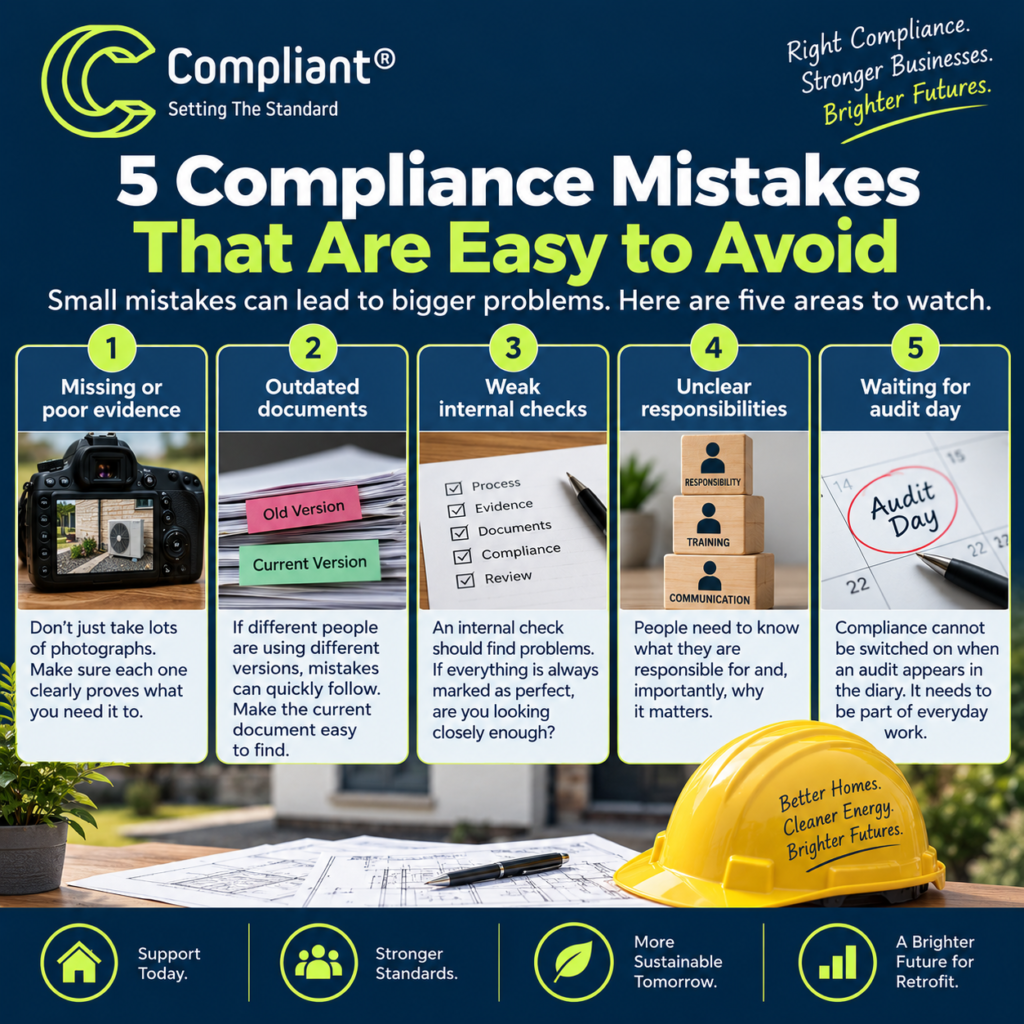
If Compliance Starts at the End of the Job, You Have Already Made It Harder


If Compliance Starts at the End of the Job, You Have Already Made It Harder
The installation is finished.
The tools are packed away.
The customer is happy.
Then someone in the office opens the job file.
A photograph is missing.
One of the records has not been completed.
There is a question about something that happened halfway through the installation.
Someone calls the installer.
“Do you remember what happened at this property?”
The installer might remember.
Or they might have completed another 15 jobs since then.
Perhaps the missing information can be found.
Perhaps somebody can return to the property.
But what happens when the work you need to prove is now hidden?
That is when a small gap can become a much bigger problem.
This is why PAS compliance should never be something a business tries to add after the installation is finished.
It needs to happen as the job happens.
Before.
During.
After.
When compliance becomes part of everyday work, it becomes easier to manage. Evidence is collected at the right time. Checks happen when they are useful. Problems can be spotted before the team leaves site.
Most importantly, the business is not trying to rebuild the story of an installation weeks or months later.
The story is being recorded as it happens.
Compliance Is Not the Final Stage
There is a common way of thinking that causes unnecessary problems.
The installation team does the “real work”.
Then the compliance work happens afterwards.
But good PAS 2030 compliance does not work like that.
Compliance is part of the real work.
Think about a typical installation journey.
There are decisions before anyone starts physical work.
There are conditions at the property that need to be understood.
There are checks.
There is installation work.
There are key stages that may need to be recorded.
There is evidence to collect.
There is information to provide.
There are records that need to tell a clear story.
If compliance only appears at the end, many of those opportunities have already passed.
You cannot always recreate them.
That is why the strongest approach is to build compliance into each stage of the job.
It should not feel like another job sitting beside the installation.
It should simply be how the installation is managed.
Start Before Anyone Arrives on Site
Good compliance starts before the van leaves the yard.
The people completing the work need the right information.
They need to understand the job.
They need to know what is expected.
And they need to know what evidence must be collected.
If important questions are still unanswered when the installer reaches the property, problems can quickly follow.
Imagine the installer arrives and finds something different from what they expected.
What should happen?
Who needs to know?
Does the proposed work need to change?
What needs to be recorded?
A good process helps people answer those questions.
A poor process leaves them to work it out themselves.
That creates inconsistency.
One installer may call the office.
Another may continue based on their own judgement.
Someone else may take photographs but forget to record why the change was necessary.
The people involved might all be trying to do the right thing, but without a clear process they can produce very different results.
Compliance management should therefore begin with good preparation.
Make sure teams know what the job involves and what is expected before work starts.
The Installer Should Not Have to Remember Everything
Installers have a lot to think about.
They are working in people’s homes.
They need to complete the installation correctly.
They need to work safely.
They may need to speak with the customer.
Conditions can change.
Problems can appear.
And somewhere among all of that, they are expected to remember every photograph, record and check required for the job.
Relying entirely on memory is risky.
Even excellent installers forget things.
That does not mean they are careless.
It means they are human.
A strong compliance process should reduce the amount people have to remember.
Simple checklists can help.
Clear stages can help.
Prompts can help.
An easy system for uploading evidence can help.
The process should guide the installer through the job rather than wait until the end and ask whether they remembered everything.
That is a major difference.
One approach prevents problems.
The other discovers them.
Evidence Needs to Be Collected When It Exists
This is particularly important for installation evidence.
Some evidence only exists for a short period.
Think about work that will later be covered.
During installation, everything may be clearly visible.
An installer can take a photograph in seconds.
Then the next stage begins.
The work is covered.
Now imagine somebody realises two weeks later that the photograph was never taken.
What happens?
You cannot simply ask the installer to take it tomorrow.
The opportunity has gone.
This is why photographic evidence should be planned around the installation.
Think in terms of pre, mid and post installation.
What needs to be recorded before work starts?
What needs to be captured while work is taking place?
What should be shown when everything is finished?
When teams know the answer before starting, evidence becomes much easier to manage.
Taking a Photo Is Not Enough
There is another problem.
A photograph exists.
Great.
But can anyone actually use it?
Perhaps it is blurry.
Perhaps it is too dark.
Maybe the important detail is outside the frame.
Or the photo is so close that nobody can understand what they are looking at.
Sometimes there are hundreds of photographs, but finding the useful ones becomes a job in itself.
Good evidence is not about taking as many pictures as possible.
It is about taking the right pictures.
A useful habit is incredibly simple:
Take the photograph.
Look at it.
Then move on.
Can you see what you intended to record?
Would somebody who was not standing beside you understand it?
If not, take another.
It may take another ten seconds.
Trying to solve the problem three months later could take hours.
The Office Cannot Fix Everything Afterwards
Sometimes compliance becomes an office problem.
Installers complete the physical work and send whatever information they have collected back to the office.
Then someone tries to make the file complete.
This person may be excellent at their job.
But they cannot create evidence that does not exist.
They cannot photograph a hidden stage of work from their desk.
They cannot know exactly what happened at 11:30 on a Tuesday morning unless somebody recorded it.
They can chase people.
They can ask questions.
They can search through photographs.
But all of this takes time.
It is also frustrating for everyone.
The office becomes frustrated because information is missing.
The installer becomes frustrated because they are being asked about old jobs.
Management becomes frustrated because completed installations are still creating work.
The answer is not simply to tell the office team to check harder.
The process needs to improve earlier.
Make Compliance Everyone’s Responsibility
PAS compliance should not belong to one person.
It is easy to appoint a compliance manager and assume that person is responsible for everything.
They have an important role.
But they cannot be on every site.
They cannot take every photograph.
They cannot carry out every check.
Good retrofit compliance requires people across the business to understand their part.
Installers need to understand what evidence they must collect.
Supervisors need to know what they should check.
Office teams need to know how records should be stored.
Managers need to understand whether the process is actually working.
Everyone does not need to know everything.
But everyone should know what they are responsible for.
That removes confusion.
It also helps prevent the dangerous assumption that “someone else will deal with it”.
Do Not Confuse More Paperwork With Better Compliance
When businesses find compliance gaps, one reaction is to create another form.
Then another checklist.
Then another sign-off sheet.
Soon the team is completing paperwork about paperwork.
That does not automatically improve compliance.
Sometimes it makes things worse.
People become tired of forms.
They rush.
They tick boxes without thinking about what those boxes mean.
Important information becomes buried among unnecessary information.
Good PAS compliance should be clear and useful.
Ask why each step exists.
What does this record prove?
Who uses it?
When should it be completed?
Does the same information already exist somewhere else?
Could the process be simpler?
Removing unnecessary steps can sometimes strengthen compliance because people can focus on the things that actually matter.
The goal is not more paperwork.
The goal is better control and clearer evidence.
Checks Work Best Before It Is Too Late
Imagine every job file is reviewed three months after completion.
You might find plenty of problems.
But what can you do about them?
Some may be impossible to fix.
Now imagine key information is checked while the installation is still happening or shortly after completion.
Suddenly, the options are much better.
The installer may still be on site.
The work may still be visible.
The customer interaction is recent.
The people involved remember what happened.
Early checks turn compliance from a historical investigation into a useful control.
This does not mean managers need to watch every minute of every installation.
It means deciding where checks provide the most value.
A few well-placed checks can prevent much larger problems later.
Month End Should Be a Review, Not a Rescue Mission
Month end is a useful time to look at performance.
How many jobs were completed?
What problems appeared?
Were there recurring evidence gaps?
Did certain stages cause difficulties?
What can be improved next month?
But month end should not be the first time anyone discovers that job files are incomplete.
If the end of every month becomes a rush to find photographs, chase installers and complete missing records, the problem is not really month end.
The problem happened earlier.
The process allowed jobs to be closed without the right evidence.
That is what needs attention.
A good month-end review should therefore focus on learning.
Look for patterns.
Perhaps the same photograph is regularly missing.
Maybe one form causes confusion.
Perhaps a subcontractor does not understand your process.
Maybe installers are collecting evidence correctly, but files are being stored in the wrong place.
Each pattern tells you something.
Do not just fix individual files.
Fix the reason the problem keeps appearing.
What Does Good PAS Compliance Look Like?
Good compliance is often less dramatic than people expect.
It is not a frantic week before an assessment.
It is not a folder created specially for an auditor.
It is not somebody staying late to chase missing evidence.
Good compliance can actually look quite boring.
And that is a good thing.
People know what they need to do.
Records are created at the right time.
Photographs are taken when the work is visible.
Checks happen naturally.
Problems are recorded.
Questions are raised early.
Completed jobs are reviewed.
When evidence is requested, people know where to find it.
There is no panic because the business is not trying to create compliance.
It has already been happening.
Train People on the Reason, Not Just the Rule
If someone is told:
“Take this photo because compliance says so,”
they may do it.
But they may not understand why the photograph matters.
Now explain:
“This part of the work will be covered in ten minutes. Once that happens, we cannot easily prove what is underneath it.”
That makes more sense.
People are much more likely to follow a process properly when they understand its purpose.
Training should therefore go beyond instructions.
Show people examples.
Show a useful photograph beside a poor one.
Explain what happens when evidence is missing.
Walk through a completed job file.
Help installers understand what somebody reviewing their work sees.
The aim is not to turn every employee into a PAS expert.
It is to give them enough understanding to do their part well.
Learn From the People Doing the Work
Compliance processes should not only flow from management to installers.
Information needs to travel the other way too.
The people using your systems every day can often see problems that managers cannot.
Perhaps an upload process takes too long on site.
Maybe a checklist asks a question at the wrong stage.
Perhaps two forms request the same information.
There may be a better way to capture evidence.
Ask.
A process that looks perfect on paper may be awkward in the real world.
That matters.
If a system is difficult to use, people will find shortcuts.
Those shortcuts can create gaps.
Listen to feedback and improve the process where appropriate.
Good compliance is not about defending a procedure because it has always existed.
It is about making sure the procedure works.
Use Problems as Information
Something will eventually go wrong.
A photograph will be missed.
A record will be incomplete.
Someone will misunderstand an instruction.
When that happens, the easiest response is to correct the person.
But that may not prevent the same problem happening again.
Ask why.
Did they know what was required?
Was the instruction clear?
Was the process practical?
Were they rushed?
Did technology fail?
Did they assume somebody else was responsible?
The answer matters.
If one person makes one mistake, it may simply be a mistake.
If five people make the same mistake, you probably have a process problem.
That distinction is important.
Good compliance management looks for causes, not just errors.
PAS Consultant Support Should Help Build Better Habits
External PAS consultant support can be useful when businesses want to understand where their processes are creating unnecessary risk.
A consultant should not simply arrive before an assessment and help tidy up paperwork.
The greater value comes from looking at how compliance works throughout the business.
Where are gaps appearing?
At what stage?
Why?
Do written procedures match what actually happens?
Are people clear about their responsibilities?
Is evidence being collected at the right time?
Are internal checks identifying problems early enough?
These questions can help turn compliance from a reactive activity into a normal part of operations.
A fresh pair of eyes can also spot things that internal teams no longer notice.
When you use the same process every day, it can be difficult to see where it is confusing or inefficient.
The purpose of support should be to make the business stronger between assessments, not simply ready on assessment day.
Good Compliance Can Save Time
This can sound strange.
Compliance is often seen as something that takes time.
And yes, collecting evidence and completing records does require effort.
But compare that with poor compliance.
How long does someone spend searching for missing photographs?
How many phone calls are made to installers?
How much time is spent revisiting old jobs?
How often does someone have to explain what happened because the original record was unclear?
How much management time goes into fixing repeated problems?
Poor processes create hidden work.
It happens days, weeks or months after the original installation.
Good processes move that effort to the point where it is easiest.
Take the photograph while you are standing there.
Record the information while you remember it.
Check the evidence before leaving.
Resolve the question while the job is active.
A few minutes at the right time can save much more time later.
Make the Right Way the Easy Way
One of the best things a business can do is make good compliance easy.
If uploading a photograph takes ten steps, people will struggle with it.
If nobody knows where documents belong, files will end up everywhere.
If instructions run to dozens of pages, people may not read them.
Simple systems encourage better habits.
The person doing the job should know:
What do I need to do?
When do I need to do it?
Where does the evidence go?
How do I know the job is complete?
That clarity is powerful.
It removes guesswork.
It creates consistency.
And it makes training new people easier too.
Look at Your Process From Start to Finish
At the end of this month, choose a handful of completed jobs.
Do not simply check whether every box has been ticked.
Follow each job as a story.
Start with what was known before the work began.
Move through the installation.
Look at the evidence.
Look at the checks.
Look at what happened after completion.
Could somebody who was not involved understand what happened?
Does the evidence support the work?
Were problems dealt with at the right time?
Where did people have to go back and fill gaps?
Those gaps are valuable.
They show you where your process needs attention.
Compliance Should Happen While the Job Happens
The best time to think about PAS compliance is not when an assessment date appears in the diary.
It is not at month end.
And it certainly is not three months after the installation when somebody discovers a missing photograph.
Compliance works best when it is built into normal work.
Prepare properly.
Give people clear responsibilities.
Collect evidence at the point it exists.
Check important information before opportunities disappear.
Review completed work.
Learn from mistakes.
Improve the process when the same problem keeps returning.
This approach does more than create better records.
It helps create consistency across the business.
And when someone asks to see the evidence, the team should not need to scramble to create a story after the event.
The story is already there.
Value-Focused CTA
As part of your next month-end review, choose three completed PAS 2030 jobs and ask one simple question:
Where did we have to go back and fix the compliance after the work had already happened?
Do not just correct those three files.
Look for the reason behind each gap.
Then ask what small change could move that task into the correct stage of the next installation.
Because good PAS 2030 compliance should not be something your team adds to a completed job.
It should be part of how a good job gets completed in the first place.